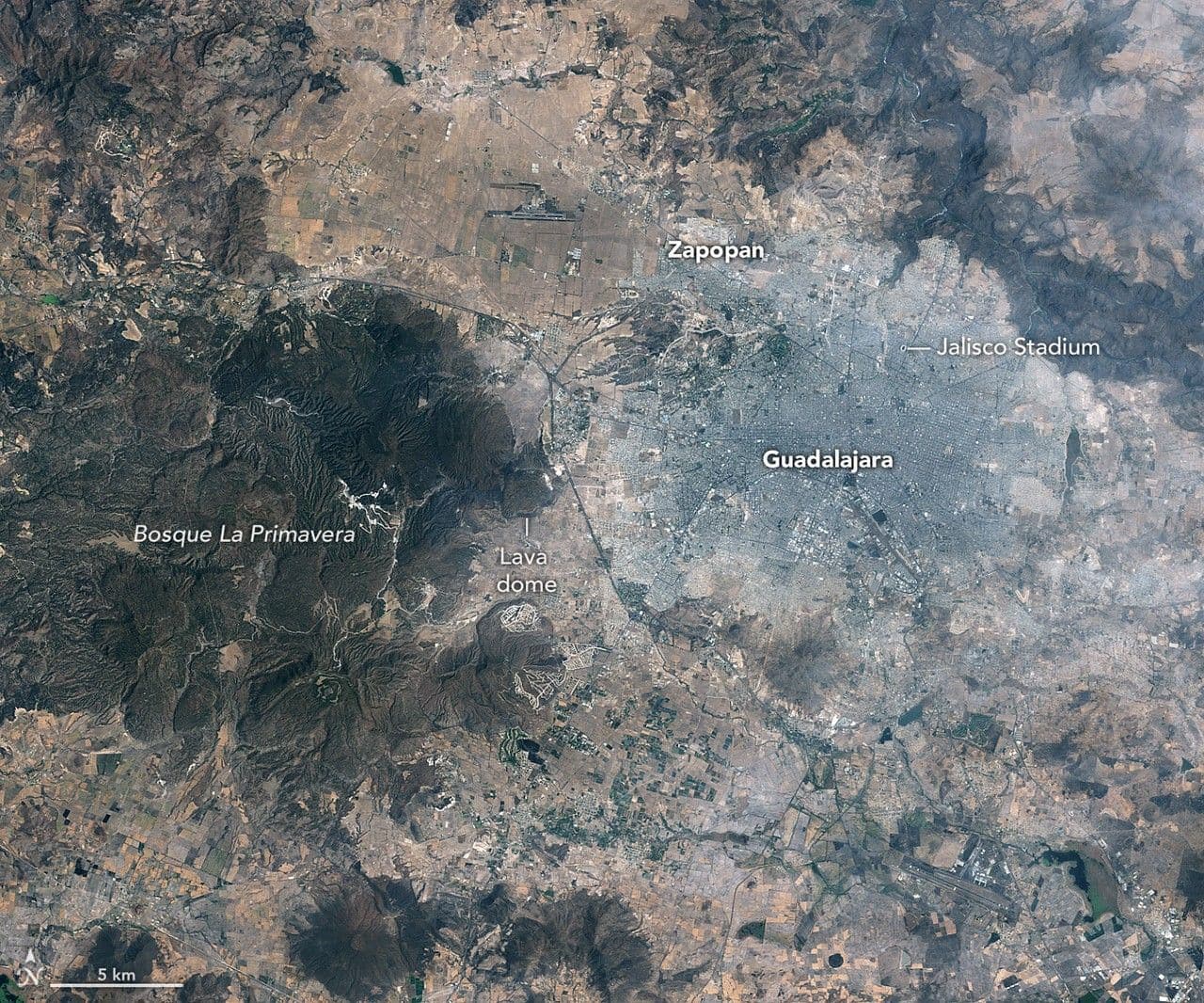
World Cup Fever in Guadalajara

The city’s metro area has pushed westward since it last hosted World Cup matches in 1986, expanding across a landscape shaped by ancient volcanoes.
Source
NASA
Opens original article in a new tab
AI Bias Analysis
4 models · Takes ~15 seconds

The city’s metro area has pushed westward since it last hosted World Cup matches in 1986, expanding across a landscape shaped by ancient volcanoes.
Source
NASA
Opens original article in a new tab

Researchers at the Federal Institute for Materials Research and Testing (BAM) outline in a perspective paper how high-performance materials for batteries, hydrogen technologies, wind turbines, energy conversion, chemical processes and modern electronics can be designed to be more sustainable, safer and more resource-efficient in the future. This is intended to address growing dependencies on critical raw materials, limited recyclability and performance losses in practical use.

Many workers fear machines will supplant them as adoption of artificial intelligence accelerates.

From paints and inks to catalysts and drug-delivery materials, many advanced technologies rely on substances dispersed in organic solvents. Yet directly observing these materials in their native liquid environments has remained a major challenge, limiting scientists' ability to understand how microscopic structures and elemental distributions influence performance.

In the U.S., unlike elsewhere in the world, the vast majority of mergers and acquisitions are conducted by "serial acquirers"—large, publicly traded firms that regularly acquire smaller companies. Around four in five M&A deals are made by these major players, including tech titans IBM, Google and Microsoft.