A Voting Machine Study the Public Isn't Allowed to See
Withholding a federal election-security review as the midterms approach corrodes trust no matter what the report actually says.
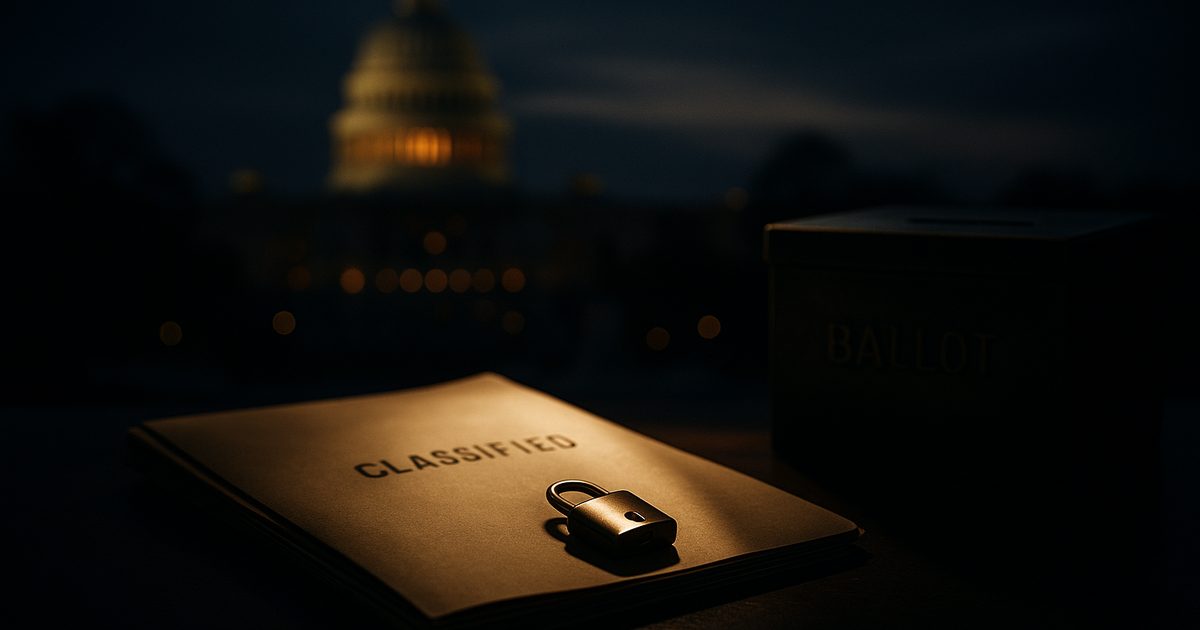
According to reporting this week, the White House has delayed the release of a federal study examining the security of US voting machines, with the timing landing squarely in the run-up to the midterm elections. The contents of the study have not been made public. We do not know whether it reassures or alarms, whether it documents serious vulnerabilities or merely catalogs routine ones. That uncertainty is precisely the problem.
There is a temptation to treat this as a minor bureaucratic hiccup - a report stuck in clearance, a victim of the usual interagency friction. We think that reading is too generous. In the specific context of American elections in this specific year, the decision to withhold an election-security study is itself a consequential act, and it deserves to be weighed as one. The information environment around voting has become so fragile that the government's choices about what to disclose, and when, now shape public trust as much as the underlying facts do.
Why Timing Is Not a Neutral Detail
Every government report goes through review, and delays are common. If this study had surfaced in an off year with no particular electoral stakes, we would not be writing about it. But a study about the machinery of voting that is held back as the midterms approach is not operating on a neutral calendar. It is operating on the most sensitive calendar in American civic life.
Consider the two scenarios. If the study is reassuring - if it finds that the machines are sound and the safeguards adequate - then withholding it deprives the public of exactly the kind of credible, government-sourced reassurance that could blunt conspiracy theories before they metastasize. If the study is troubling - if it identifies vulnerabilities that election officials should address - then withholding it deprives those officials of time to act before ballots are cast. There is no version of the contents that makes the delay obviously justified. In one case the public loses reassurance; in the other it loses preparation. Either way, the loss is borne by voters.
This asymmetry is what separates election-security transparency from ordinary government secrecy. Most withheld documents involve a genuine trade-off: disclosure might compromise an investigation, a negotiation, or a source. Here, the case for secrecy is far weaker, and the case for openness is reinforced by the unique fact that elections only function if people believe in them.
The Strongest Case for Holding the Report
We owe the other side a fair hearing, because there is a real argument here. Election-security findings can be genuinely dangerous in the wrong hands. A study that itemizes specific vulnerabilities in specific equipment could serve as a roadmap for a bad actor - foreign or domestic - looking to exploit them. Responsible disclosure in cybersecurity often involves a quiet period during which defenders patch a hole before attackers learn it exists. By that logic, a government might reasonably want to brief election officials privately, let them remediate, and only then publish.
There is also the matter of premature alarm. A raw technical assessment, full of caveats and hypotheticals, can be stripped of context and weaponized by anyone with an agenda. Officials might argue that releasing such a document into a charged pre-election atmosphere would do more to undermine confidence than to inform it. These are not frivolous concerns, and any editorial that pretends otherwise is not arguing in good faith.
Why That Case Falls Short Here
But the responsible-disclosure analogy only works if the withholding comes with a credible, transparent plan and a public timeline. The cybersecurity model does not end in permanent silence; it ends in publication after remediation. What reporting describes is a delay tied to the political calendar, not to a technical remediation schedule. That distinction matters enormously. A pause to fix problems is governance; a pause that conveniently outlasts an election is something closer to message control.
The specific-vulnerabilities concern is also addressable without total secrecy. Governments redact. They publish executive summaries that convey conclusions while shielding exploit details. They release the reassuring topline and brief the sensitive specifics to cleared officials. The all-or-nothing choice - either dump the full technical study or release nothing - is a false one, and choosing the nothing end of it should not be mistaken for caution.
As for premature alarm: the alarm is already here. We do not live in a country where Americans calmly trust their voting infrastructure and a leaked study might disturb that peace. We live in a country where a substantial share of voters across the political spectrum already harbor doubts, where claims of rigged machines have circulated for years, and where the absence of authoritative information is filled instantly by speculation. In that environment, silence does not preserve calm. It manufactures suspicion. A withheld study becomes a Rorschach test onto which every faction projects its worst fears.
The Trust Problem Is the Whole Game
The deeper issue is that American elections run on a currency that cannot be printed on demand: legitimacy. A voting system can be technically flawless and still fail if the losing side does not accept the outcome. Conversely, a system with known, manageable imperfections can function well if both winners and losers trust the process that produced the result. Legitimacy is built through transparency, predictability, and the steady demonstration that nobody is hiding the ball.
This is why the manner of this delay is so corrosive regardless of intent. Even if the people who chose to hold the study did so for entirely defensible reasons, the structure of the decision - a government withholding election information from the governed, with the convenient effect of keeping it out of public view until after votes are counted - reads as exactly the kind of behavior that erodes trust. And once that suspicion takes hold, it is nearly impossible to dislodge after the fact. A report released in the calmer aftermath will always carry the asterisk of having been held back when it mattered.
We would say the same thing about any administration of any party. The principle does not bend to who occupies the White House. The custodians of election information hold a public trust, not a political asset, and the default for information about how Americans vote should be disclosure, with the burden of proof falling on those who would withhold it.
What Should Happen Now
The path forward is not complicated. The administration should publish the study's findings on a clear, announced timeline, redacting only the narrow technical details that could serve as an attacker's blueprint, and releasing the conclusions and recommendations in full. If specific vulnerabilities require remediation, officials should say so, describe the plan, and commit to publishing the complete assessment once fixes are in place. Independent election officials and nonpartisan technical reviewers should be looped in, so that the public is not asked to take any single political actor's word for what the report does or does not contain.
Congress, for its part, should not treat this as an executive-branch housekeeping matter. Oversight committees can and should ask why the study is being held, on what schedule it will be released, and who made the call. These are reasonable questions with reasonable answers - if the answers exist.
An election-security study that the public cannot see does not make elections more secure. It makes them feel less so. In a year when the country can least afford another reason to doubt its own ballots, the government has handed skeptics a gift and given everyone else a fresh worry. The fix is to open the file. The longer it stays closed, the more it will be assumed to contain the worst.
Frequently Asked Questions
Does releasing a voting machine study risk helping attackers?
It can, if the study contains specific technical exploit details. But that risk is managed through redaction and executive summaries, not blanket secrecy, so the all-or-nothing framing is misleading.
Isn't it normal for federal reports to be delayed?
Routine delays happen constantly and rarely matter. What makes this case different is the subject - election security - and the timing, with a delay that conveniently extends past the midterms rather than tracking a technical remediation schedule.
Why does transparency matter so much for elections specifically?
Elections depend on legitimacy, which requires losers to accept results. Trust is built through openness and predictability, so withholding election information tends to breed suspicion that can outlast and outweigh any technical concern.