
America's Strategic Oil Reserve Just Hit a 43-Year Low. What Happens If It Gets Too Low?
The US is draining its emergency oil at close to the fastest rate it can sustain, the Strait of Hormuz is still contested, and the oil price is somehow falling. Here is why the calm is borrowed time.
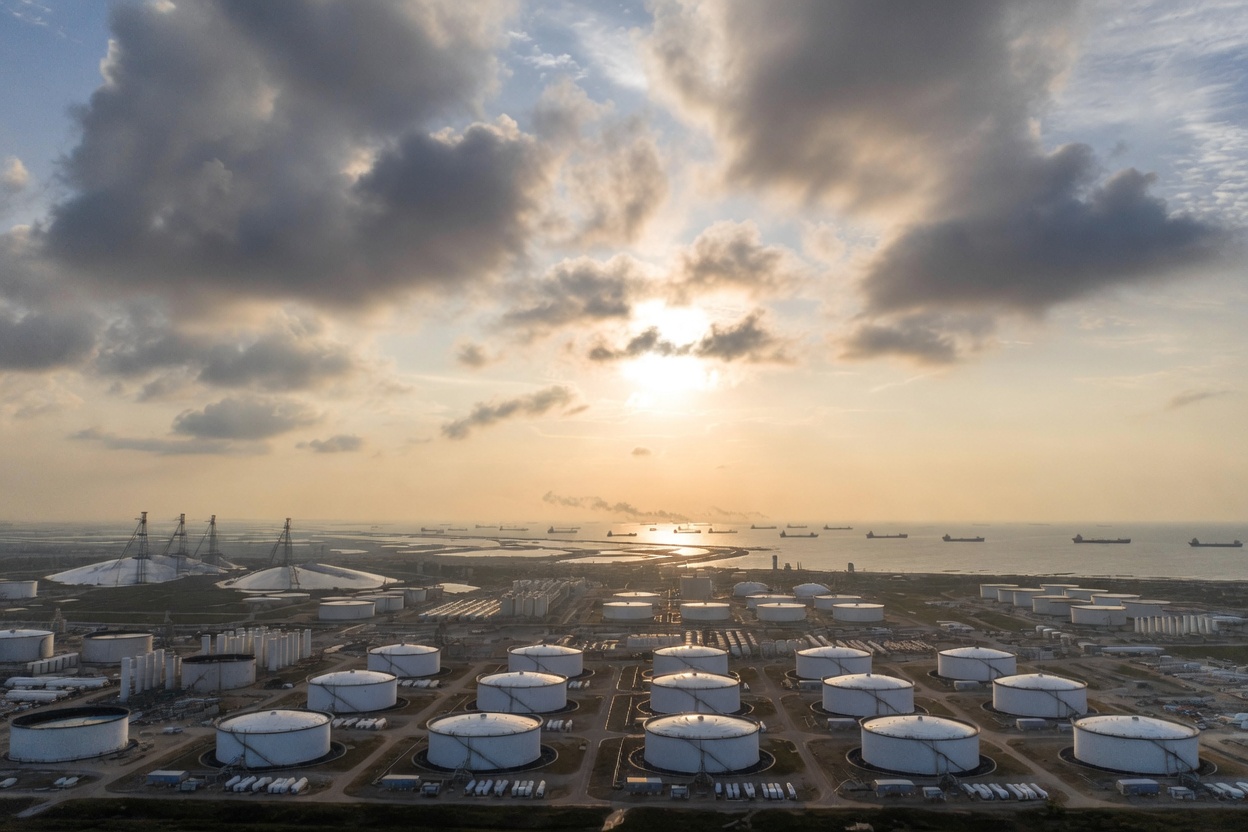
There is a stretch of the Texas and Louisiana coast where the United States keeps its emergency oil in salt caverns carved deep underground. As of the week of July 17, that stockpile held about 311 million barrels. The last time it was this low, Ronald Reagan was in his first term and a barrel of crude cost less than a movie ticket does today.
The Strategic Petroleum Reserve has lost roughly half its oil in five years. Right now the Energy Department is pulling close to 1.4 million barrels a day out of the ground and pushing it into a market that has been strained since Iranian forces began attacking tankers in the Strait of Hormuz in March. Washington is not doing this alone. The July draw is part of a coordinated release by 32 nations, the largest joint intervention in the history of the reserve system.
And yet the price of oil, the one number most people actually watch, has spent the summer drifting lower. That gap between a historic supply shock and a strangely quiet market is the story worth understanding, because it explains both why the crisis has been survivable so far and why the hardest part may still be ahead.
Why the reserve exists, and why 1975 still matters
The reserve was born out of a bad memory. In 1973 and 1974, an Arab oil embargo sent American drivers into gas lines and the economy into a tailspin. Congress responded in 1975 with the Energy Policy and Conservation Act, which created a federal crude stockpile meant to blunt exactly that kind of shock. The government chose salt caverns on the Gulf Coast because salt formations are cheap, secure, and stable enough to hold oil for decades.
At its peak in 2009, the reserve held 727 million barrels. It has been tapped only sparingly in the decades since. Presidents authorized emergency sales during the 1991 Gulf War, after Hurricane Katrina wrecked Gulf production in 2005, and during the 2011 Libya conflict. The largest drawdown before this year came in 2022, when President Biden released 180 million barrels after Russia invaded Ukraine. That record stood for less than four years.
The reserve was designed to move oil fast in a genuine emergency. Its technical drawdown capacity runs to about 4.4 million barrels a day, though the fastest sustained rate the system has ever actually delivered is closer to 1.4 million. That distinction matters now, because the current draw is running near that real-world ceiling, not the theoretical one. The buffer is being used at close to the pace it can physically sustain.
The market puzzle nobody expected
By the ordinary logic of supply and demand, oil should be far more expensive than it is. Roughly a fifth of the world's oil normally passes through the Strait of Hormuz. According to the International Energy Agency, world output has been running about 9.4 million barrels a day below pre-war levels, and global supply is on track to fall by an average of 3.7 million barrels a day this year. A shock of that size would, in most textbooks, send prices to record highs and keep them there.
For a few weeks in March, it did. North Sea Dated crude, a global benchmark, spiked to around $130 a barrel, some $60 above where it sat before the conflict, in the largest monthly gain on record. Then something odd happened. By late April, Brent crude was swinging between $118 and the low $70s within the same quarter. On June 26 it touched $72, below where many analysts had it before the war started.
Three forces are holding the line, and it is worth being clear-eyed about each. The first is demand destruction, which is a clinical term for a painful reality. High prices, fuel rationing, and government conservation orders have pushed global consumption down by roughly a million barrels a day compared with last year, with the steepest cuts in Asia. The world is using less oil in part because a lot of people and businesses can no longer afford as much of it.
The second is rerouting. Saudi Arabia and the United Arab Emirates have shifted some exports to terminals that sit outside the Strait, using pipelines that carry crude to the Red Sea and the Gulf of Oman. Those routes cannot replace everything Hormuz moves, but they have kept a meaningful share of Gulf oil flowing to buyers.
The third is the reserves themselves. The coordinated releases from the United States and its allies, together with draws on commercial storage, have plugged much of the gap between what the market needs and what producers can currently deliver. That is the reserve doing precisely the job it was built for.
Where does China fit, and why does it change the math?
No country matters more to this story than China, and on the surface no major economy looks more exposed. China is the world's largest crude importer, buying roughly 11.5 million barrels a day in 2025 and briefly closer to 12 million early this year. It draws about 5.4 million barrels a day through the Strait of Hormuz, more than double what it imports from Russia. A closed Strait should, in theory, hit Beijing harder than almost anyone.
It has not, because China saw the war coming and bought ahead of it. In the first two months of 2026, as tensions with Iran escalated, Chinese crude imports jumped nearly 16 percent as refiners rushed to fill tanks. By the time the shooting started, China had amassed an estimated 1.2 to 1.4 billion barrels across commercial and strategic storage, a private cushion that dwarfs the 311 million barrels left in the American reserve. Roughly 360 to 409 million of that sits in government hands, enough for something like 104 to 115 days of cover.
Now China is spending that cushion, and the way it is doing so helps explain the quiet oil price. Its crude imports collapsed to about 7.8 million barrels a day in May, the lowest in more than eight years and a 28 percent drop from April, as refiners drew down stored barrels rather than chase cargoes at war prices. When the world's biggest buyer steps back from the market, cargoes that would otherwise be fought over find fewer bidders, and prices ease for everyone.
Beijing is also turning the crisis to its advantage. The independent "teapot" refiners clustered in Shandong province have rushed to buy discounted Iranian and Russian crude that Western firms will not touch, a trade that keeps China's state-owned giants at arm's length from sanctioned barrels. Washington sanctioned at least one teapot refinery in April for exactly this. Much of the Gulf oil the West describes as trapped is, in practice, finding a buyer at a discount in China. The same disruption draining America's reserve is letting its chief rival top up on cheap crude while drawing down a stockpile it built for this exact moment. That asymmetry, more than any single price print, is what should focus minds in Washington.
The barrels you never see
Most of the attention goes to gasoline and diesel, because those are the prices people meet at the pump. The less visible damage is happening one step down the chain, in the refineries and petrochemical plants that turn crude into the raw material for modern life.
Global refinery runs have fallen about 6 million barrels a day year on year, as Middle East export refineries sit idle and Russian plants absorb repeated strikes. The IEA estimates that attacks knocked out as much as 40 percent of Russian refining capacity through July and August. More than 4 million barrels a day of refining capacity is at risk of being cut or shut entirely. When refineries slow down, they stop producing more than fuel.
Take naphtha, a refined product that is the primary feedstock for plastics. Its price in Singapore has pushed past $1,000 per metric ton, and the squeeze has forced petrochemical plants across Asia to curb output of the polymers that become packaging, pipes, car parts, and medical devices. LyondellBasell, one of the world's largest chemical companies, declared force majeure on several European polymer lines, telling customers it could no longer guarantee supply at sustainable cost.
Then there is fertilizer. The ammonia and urea that farmers depend on are made from natural gas and hydrocarbons that the Gulf normally exports, much of it through Hormuz. A large share of that supply is now trapped inside the Persian Gulf, unable to reach world markets on the usual routes. Helium, a byproduct of Gulf gas processing that keeps MRI machines and semiconductor plants running, is caught in the same bottleneck. Diesel and jet fuel, the workhorses of freight and aviation, are the products analysts consider most vulnerable to a prolonged loss of Middle East refining, because there is little spare capacity elsewhere to make up the difference.
Follow that chain out far enough and it reaches a dinner table and a hospital. Costlier fertilizer means costlier food, especially in countries that import both. Scarcer petrochemicals mean higher prices and thinner supply for plastics that go into everything from IV bags to crop films. These effects arrive slowly and unevenly, which is exactly why they are easy to underestimate while the oil price stays quiet.
Everyone else's cushion
The United States is not the only country with a reserve, and the comparison is unflattering. China, as noted, holds the largest stockpile in the world by a wide margin. It has plenty of company among the prepared, and rather less among the exposed.
The wealthy importers of East Asia went into this crisis better prepared than almost anyone. Japan holds roughly 263 million barrels in government reserves, close to 260 days of supply. Singapore sits near 245 days, South Korea near 210. Those buffers are the product of decades of policy in economies that import nearly all of their oil and never forgot how exposed that makes them.
India is the cautionary case. Its strategic reserve has a capacity of under 40 million barrels and covers only about 25 days of demand, leaving the world's most populous country with one of the thinnest margins among major economies. The United States, counting all commercial and government stocks together, has roughly 200 days of cover, which sounds comfortable. The Strategic Petroleum Reserve itself, the part the government can actually deploy at will, is the piece running low.
Under the International Energy Agency framework, member countries pledge to hold reserves equal to at least 90 days of net imports. That standard was written for a shock that lasts weeks. It was never meant to be the sole line of defense against a supply disruption stretching across a full year.
Where it lands hardest
A global average hides who actually pays. Asia has become the epicenter of the crisis because it leans most heavily on Middle Eastern crude. Japan and South Korea import more than 80 percent of their energy, which leaves even their deep reserves under strain. The Philippines, which imports about 98 percent of its oil, declared a national energy emergency after supplies tightened.
Further down the income ladder the picture turns grim. Sri Lanka, still fragile from its recent financial collapse, is among the hardest hit. Ethiopia, Thailand, Vietnam, and a number of African nations are managing rationing and rotational blackouts. The pattern is consistent and cruel: the countries least able to afford the premium of stockpiling oil are the ones getting squeezed first and hardest. The Asian Development Bank cut its 2026 growth forecast for developing Asia to 4.7 percent from an earlier 5.1 percent, a downgrade that represents millions of jobs and livelihoods.
The cost shows up in places that never make headlines. War-risk insurance on a Hormuz tanker transit has jumped from about a quarter of a percent of the vessel's value to somewhere between 3 and 10 percent, turning a premium of a few hundred thousand dollars into 5 to 7.5 million dollars per voyage. VLCC freight rates from the Gulf to China spiked 24 percent in a single day at one point, and tanker owners earned north of $500,000 a day on some routes at the peak. Every one of those costs eventually reaches a consumer somewhere.
The refill nobody wants to pay for
Even when the shooting stops, the reserve does not refill itself. The Energy Department estimated that topping the stockpile back up would cost around $20 billion, on top of $100 million to more than $200 million in repairs to aging infrastructure that decades of use have worn down. Buying that much oil would also, by definition, add a large new buyer to a market already short of supply, which risks pushing prices back up just as they begin to ease.
There is a subtler problem in the chemistry. The reserve was built on a roughly 60/40 mix of sour to sweet crude, and the barrels the Gulf disruption pulled off the market were mostly the sour grades that American and allied refiners need to keep their diesel units full. The Energy Department's first exchange solicitation, covering 86 million barrels, was mostly sour for exactly that reason. Replacing those specific barrels, in a world where the usual sour supply is stuck behind a blockade, is harder than a headline number suggests.
Insurers offer one tentative sign of hope. The Joint War Committee, which sets the risk designations that drive shipping premiums, could begin phasing down the Hormuz listing in the fourth quarter of this year if conditions hold, with full removal possible by early 2027. That would lower costs and coax tankers back through the Strait. It depends entirely on the fighting not flaring again, and the escalation on July 7 and 8, which drove transits below 10 percent of their pre-war baseline, is a reminder of how fragile that assumption is.
So where does that leave the reserve, and the country that depends on it? The buffers have held for four months, which is a genuine achievement of coordination among the United States and its allies. The question the quiet oil price cannot answer is what happens if the conflict grinds on into next year, after demand has been squeezed as far as it can go and the tank on the Gulf Coast is thinner still. The reserve was built to bridge a gap. It was never built to be the bridge itself, indefinitely, for the whole world.
Frequently Asked Questions
What is the US Strategic Petroleum Reserve level as of July 2026?
As of the week of July 17, 2026, the reserve held roughly 311 million barrels, down from about 316.5 million on July 10 and 319.5 million at the start of the month. That is its lowest level since April 1983, and represents a decline of close to 49 percent over the past five years.
How much oil is the US drawing from the reserve each day?
The Energy Department is releasing oil at close to 1.4 million barrels a day, part of a 172 million barrel authorization issued in March 2026 to be delivered over roughly 120 days. That pace sits near the fastest rate the reserve system has historically been able to sustain, and the release is coordinated with a larger 400 million barrel effort involving 32 nations.
Why have oil prices not soared despite the Strait of Hormuz disruption?
Three forces are offsetting the supply loss. Demand has fallen by roughly a million barrels a day as high prices and rationing curb consumption, especially in Asia. Saudi Arabia and the UAE have rerouted some exports through pipelines that bypass the Strait. And strategic and commercial reserves are being drawn down to fill the gap. Prices spiked to around $130 in March before falling back toward $72 by late June as those buffers took hold.
Which oil byproducts are affected by reduced refining capacity?
Cutbacks in refining hit far more than fuel. Naphtha, the main feedstock for plastics, has passed $1,000 per metric ton in Singapore and forced petrochemical plants to curb output. Fertilizer inputs such as ammonia and urea, along with helium used in medical and semiconductor equipment, are stuck inside the Persian Gulf. Diesel and jet fuel are considered the most exposed refined products.
Which countries are hit hardest by the oil supply crisis?
Asia is the epicenter. Japan and South Korea import more than 80 percent of their energy, and the Philippines declared a national energy emergency. Lower-income nations including Sri Lanka, Ethiopia, Thailand, and Vietnam face rationing and blackouts, because they are least able to afford large strategic stockpiles. The Asian Development Bank cut its 2026 growth forecast for developing Asia to 4.7 percent.
Do other countries have strategic oil reserves, and how large are they?
Yes. China holds the largest reserves, with government stocks estimated at 360 to 409 million barrels and commercial inventories near 1.4 billion barrels, covering about 104 to 115 days. Japan holds roughly 260 days of supply, Singapore around 245, and South Korea near 210. India is far more exposed, with only about 25 days of cover. IEA members are pledged to hold at least 90 days of net imports.
How is China affected by the Strait of Hormuz oil crisis?
China is the world's largest oil importer and draws around 5.4 million barrels a day through the Strait, more than double its imports from Russia, which makes it the most exposed major economy on paper. But it prepared. Beijing stockpiled an estimated 1.2 to 1.4 billion barrels before the war and has since leaned on that cushion, cutting imports to about 7.8 million barrels a day in May, the lowest in eight years. Its independent refiners are also buying discounted Iranian and Russian crude, leaving China better insulated than most and, in some ways, advantaged by the crisis.