
The Yen Carry Trade Is Quietly Unwinding, and Markets Aren't Ready
Rising Japanese rates and a falling yen have rebuilt the same leveraged trade that triggered the August 2024 global selloff, and this time the position behind it is larger.
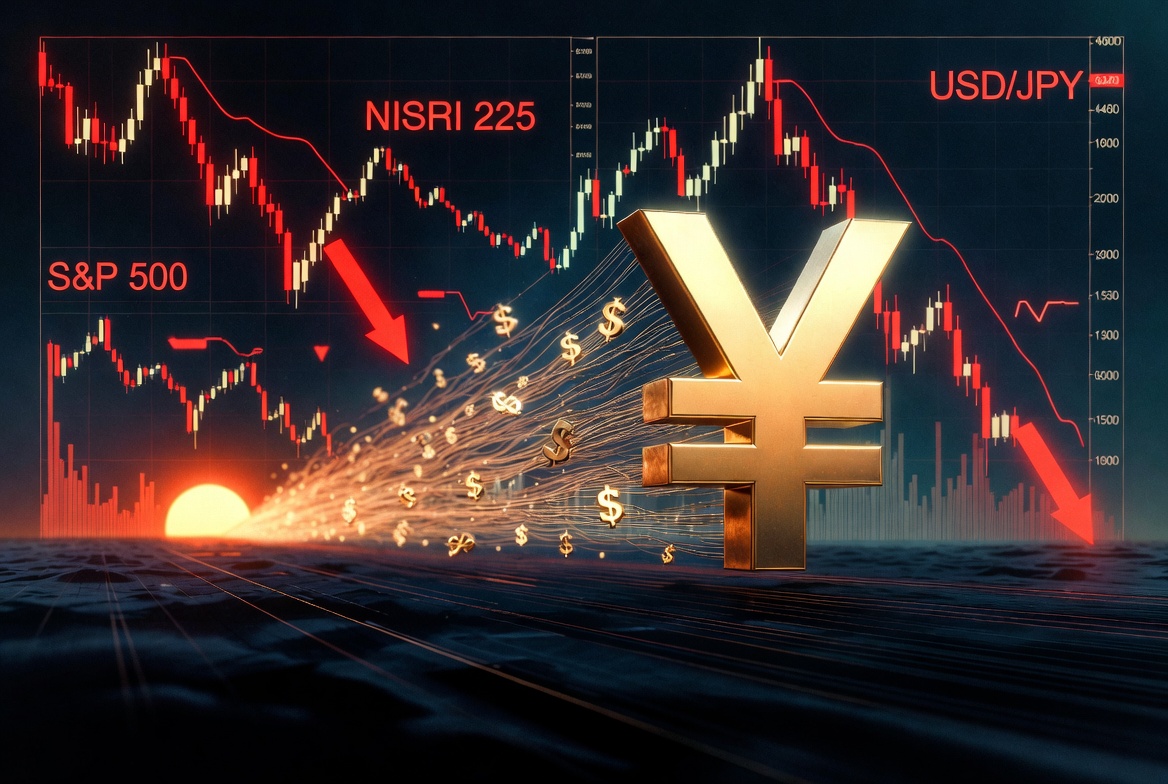
For most of the past two years, the yen carry trade has been one of the quieter engines behind the rally in almost everything. Investors borrowed yen at rates close to zero, converted the proceeds into dollars, and put the money into whatever paid more, Treasurys, mega-cap tech stocks, emerging-market debt, Bitcoin. It worked so reliably for so long that many investors stopped treating it as a trade at all. It became a background assumption. The past several weeks of data suggest that assumption is being tested again.
The Bank of Japan has raised its policy rate to 1%, the highest level in 31 years, and officials have said plainly that they are not done. Yields on Japanese government bonds have climbed to levels last seen before the 2008 financial crisis. Under normal logic, both developments should make the yen more attractive to hold and more expensive to borrow. Instead, the currency has slid to around 162 per dollar, near its weakest level in roughly four decades. Rates rising, currency falling: that combination does not resolve itself quietly. It tends to resolve itself all at once.
A Trade Built on a Rate Gap That Is Narrowing
The mechanics are straightforward. As long as it costs less to borrow yen than an investor can earn holding dollar assets, the trade prints money with very little effort. The gap between U.S. and Japanese rates has been the widest in decades, which is what made the trade so popular in the first place. That gap is now narrowing, slowly, as the Bank of Japan tightens. History says a shrinking rate gap does not deflate a crowded trade gently. It usually needs a trigger, and traders spend a lot of time trying to guess what that trigger will be.
We got a preview of what a trigger looks like in August 2024. A quarter-point rate increase from the Bank of Japan, landing the same weekend as a soft U.S. jobs report, was enough to flip the yen's direction and set off a rush to unwind. Funds that had borrowed cheap yen were suddenly forced to buy it back to cover their positions, and to raise the cash they sold the assets the borrowed money had funded, which happened to be the market's most crowded winners. Tokyo had its worst single session since 1987. The Cboe Volatility Index touched a level it had reached only twice before in its history. Bitcoin lost roughly a fifth of its value in 48 hours.
The Recovery Masked the Real Lesson
Within about a week, most of the damage had reversed. That speed is exactly why the episode gets remembered as a blip rather than a warning. But nothing about the underlying trade was fixed in August 2024. The positions were simply rebuilt, and rebuilt at scale. Data from futures markets now show speculative accounts holding their largest net-short position in the yen since 2017. The crowd, in other words, went right back to the trade that had just punished it.
That is the part of this story that belongs on the front page rather than in a footnote, because the yen carry trade is not really a story about Japan. It is a story about how much of the current market, across asset classes that look unrelated on the surface, is financed by the same cheap borrowing. The assets that would be sold first in an unwind, large-cap AI-linked stocks, momentum-driven funds, crypto, emerging-market favorites, are not a random group. They are the assets that rose the most on borrowed money and that trade in markets liquid enough to sell quickly when cash is needed. That is why a shock that starts in Tokyo can show up in a U.S. retirement account before the close of trading. Diversification offers less protection than investors assume once correlations across seemingly unrelated assets start moving toward one.
Why the Carry Trade Can Stay Stretched
None of this points to a specific date on the calendar, and we are not forecasting one. Carry trades have a long history of staying profitable well past the point where caution would suggest otherwise. The interest-rate gap between the U.S. and Japan, though narrower than it was, is still wide enough to keep paying for now. The more likely path from here is a grind rather than a crash: the Bank of Japan raising rates in careful steps, the yen strengthening unevenly, the trade unwinding in an orderly fashion over months rather than hours. That is the outcome we would bet on. But a reasonable base case is not the same thing as a safe one, and prudent investors do not insure only against the outcome they expect.
What Investors Should Do With This
The right response is neither to exit everything nor to ignore the signal. It is to use a visible warning to do the unglamorous work that a fast unwind makes difficult later. Reduce leverage where it has built up, since leverage is precisely what an unwind punishes hardest. Hold real cash, both to absorb a drawdown and to buy into the recovery instead of selling into the panic. Trim positions that have grown oversized and crowded. Tilt part of the portfolio toward assets that have historically held up or gained when carry trades unwind: the yen itself, high-quality government bonds, gold, and businesses with steady, domestically generated cash flow. The point is not to call the exact moment the trade breaks. It is to be the investor who is not a forced seller when it does.
The broader lesson outlasts this particular trade. A market that can be rattled this hard by a rate decision from a central bank on the other side of the world is a market carrying more borrowed conviction than it usually cares to admit. The yen carry trade is worth watching not only for what it could do to portfolios next quarter, but for what it says about the market all of us share: leveraged, tightly interconnected, and still betting that cheap money keeps flowing. That bet is being tested again, and this time the position behind it is bigger than it was in August 2024.
Frequently Asked Questions
What is the yen carry trade?
It is a strategy in which investors borrow Japanese yen at low interest rates, convert the money into another currency, and invest it in higher-yielding assets abroad, profiting from the difference in rates as long as the yen does not strengthen enough to erase the gain.
Why did the yen carry trade cause a market selloff in August 2024?
A Bank of Japan rate increase raised the cost of holding yen debt just as a weak U.S. jobs report hit sentiment, prompting leveraged investors to unwind their positions quickly. That forced selling of stocks and other assets, triggering sharp declines across global markets in a matter of days.
Is the yen carry trade unwinding again in 2026?
Data show renewed strain: the Bank of Japan has raised rates to 1%, a 31-year high, while the yen has fallen to roughly 162 per dollar. Speculative positioning against the yen is near its largest since 2017, conditions similar to those that preceded the August 2024 unwind.
How can investors protect themselves from a carry trade unwind?
Common approaches include reducing leverage, keeping cash reserves on hand, trimming oversized positions in crowded trades, and holding assets that tend to perform well during carry unwinds, such as the yen, high-quality bonds, and gold.
Update, Aug. 12, 2026: Read our follow-up, “Washington’s Yen Intervention Was Aimed at the Treasury Market,” on the coordinated U.S.-Japan currency intervention and what it means for this trade.