
America's New Indonesian Gambit: Geography, Energy, and the Logic of Sea Power
Washington's new Major Defense Cooperation Partnership with Jakarta is a calculated move to tighten American influence over the world's most consequential energy chokepoint, and to ensure Beijing cannot forget it.
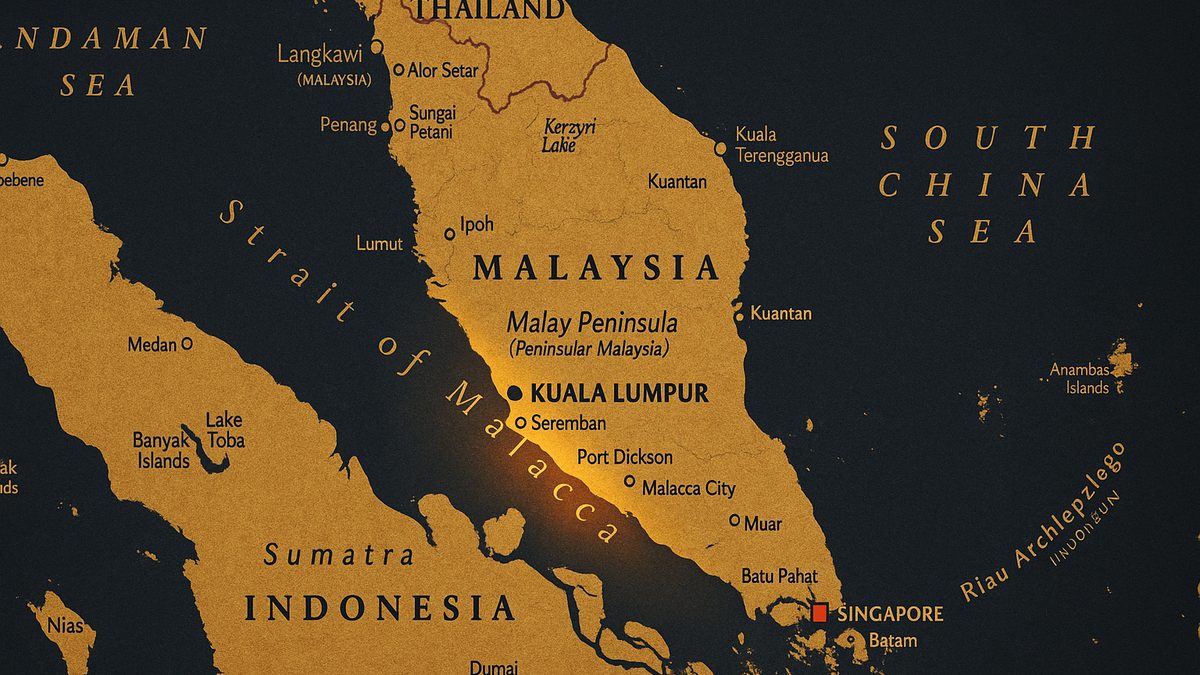
The Strait of Malacca is 1.7 nautical miles wide at its narrowest point. That sliver of water between the Malay Peninsula and the Indonesian island of Sumatra carries roughly 23 million barrels of oil every day, accounting for nearly 29 percent of all global maritime oil shipments. It handles two-thirds of China's total trade volume and, depending on the measure used, somewhere between 80 and 83 percent of its crude oil imports. No other nation's economic lifeline is so thoroughly concentrated at a single geographic bottleneck it does not control.
Washington moved this week to remind Beijing of that fact.
On April 13, U.S. Secretary of Defense Pete Hegseth hosted Indonesian Defense Minister Sjafrie Sjamsoeddin at the Pentagon and announced the elevation of the bilateral defense relationship to a Major Defense Cooperation Partnership, or MDCP. The joint statement outlined three pillars: military modernization and capacity building, training and professional military education, and expanded joint exercises and operational cooperation. Beneath those carefully neutral phrases lies a more pointed strategic logic, one that James E. Thorne, Chief Market Strategist at Wellington Altus, has described as "pure Mahan."
A Dilemma Twenty Years in the Making
In November 2003, Chinese President Hu Jintao gave the strategic anxiety a name. At a Communist Party Economic Work Conference, he coined the phrase "Malacca dilemma" to describe what he saw as his country's central vulnerability: China's economic ascent depended on imported energy that arrived by sea through a narrow passage that other powers could, in a crisis, choose to close. The concern was not hypothetical. The U.S. Navy has operated in Indo-Pacific waters for decades, and any serious conflict, over Taiwan, the South China Sea, or elsewhere, would bring that presence into direct contact with China's tanker lanes.
More than two decades later, the dilemma has been managed but not resolved. China has invested heavily in alternatives: the Power of Siberia pipeline from Russia, the China-Pakistan Economic Corridor, overland routes through Central Asia, a Myanmar pipeline from the Bay of Bengal into Yunnan province, and a strategic "string of pearls" of port investments from Gwadar to Djibouti. The volumes tell a sobering story about how much those investments have actually shifted the underlying exposure. In the first half of 2025, China remained the single largest destination for crude oil passing through the Strait of Malacca, taking in 7.9 million barrels per day, 48 percent of all import volumes through the strait, according to the U.S. Energy Information Administration. Russia's ESPO pipeline, the most effective overland workaround, carries around 700,000 barrels per day. The math does not close.
Complicating the picture further, the conflict between the United States and Iran that began in late February has effectively closed the Strait of Hormuz, through which roughly 39 percent of global seaborne crude oil normally transits. That disruption has sent oil prices sharply higher and focused global attention on chokepoints in ways not seen in a generation. In that context, the Malacca Strait has moved from a theoretical vulnerability on a Chinese defense planner's spreadsheet to an active, live pressure point on the world's largest economy.
What the MDCP Actually Does
The formal language of the MDCP is anodyne. Both countries affirm mutual respect, sovereignty, and shared commitment to Indo-Pacific peace and stability. Indonesia's Defense Ministry was careful to note that a U.S. proposal to grant American military aircraft blanket overflight access to Indonesian airspace is still "being carefully reviewed" and requires further technical negotiation.
Strip away the diplomatic cushioning, and the operational content of the agreement is pointed. The two sides have committed to co-developing, in the joint statement's words, "sophisticated asymmetric capabilities" and "next-generation defence technologies in the maritime, subsurface and autonomous systems domains." They have pledged to expand joint special forces training and to broaden participation in multinational exercises, including Super Garuda Shield. Both countries will also work on maintenance, repair, and overhaul cooperation to improve operational readiness.
What this amounts to, as Thorne observes, is a significant expansion of maritime domain awareness at the precise chokepoint where China's economic lifeline is most exposed. Indonesian officers training alongside American counterparts, integrated surveillance systems, expanded subsurface and autonomous patrol capabilities: each of these changes, incrementally, the operational picture that any Chinese planner must account for when gaming out a crisis scenario. The result does not require Indonesia to formally take Washington's side. It simply requires that Jakarta's forces see more of what moves through its adjacent waters, and that what they see is shared.
Mahan's Logic, Updated for the Energy Age
Alfred Thayer Mahan, the American naval theorist whose 1890 work "The Influence of Sea Power upon History" reshaped how great powers thought about maritime strategy, argued that nations whose commerce moved by sea would ultimately be shaped, constrained, and in extremis defeated by whoever controlled the ocean's critical passages. Fleets, chokepoints, and the security of trade routes were, in his view, the real determinants of national power. A continental power that left the seas to others had accepted a permanent, structural limitation on its ambitions.
China, despite its decades of naval buildup under what the People's Liberation Army Navy calls its "Far Seas Protection" doctrine, remains precisely the kind of continental power Mahan would have recognized. The PLAN has surpassed the U.S. Navy in total vessel count. It has built artificial islands across the South China Sea and developed blue-water capabilities it did not possess a generation ago. And yet approximately 80 percent of its crude oil still arrives by tanker through Southeast Asian straits it does not control and cannot unilaterally defend.
The Trump administration's approach to the Indo-Pacific has been Mahanian in its underlying logic. From announcements about rebuilding American shipyards to the pattern of defense deepening with Indonesia, the Philippines, Japan, and Australia, the posture is consistent: tighten American influence at the maritime chokepoints through which China's economy breathes, and ensure Beijing feels the weight of that geography whenever it contemplates assertive action. The Indonesia MDCP is the latest addition to that pattern, fitting a recognizable architecture that has been quietly assembled over the past year.
Indonesia's Balancing Act and Its Limits
Jakarta has been emphatic on one point: it is not choosing sides. Indonesia's foreign policy tradition of strategic non-alignment, what it calls its "free and active" posture, has deep institutional roots and domestic political salience. President Prabowo Subianto was in Paris meeting with French President Emmanuel Macron at the time of the signing, having recently met with Russian President Vladimir Putin as well, a deliberate signal of continued multi-directional engagement. The Defense Ministry's careful hedging on U.S. overflight access underscores that Jakarta intends to preserve its room for maneuver.
But as Thorne notes, Indonesia does not need to choose sides for this pact to carry strategic consequences. The operational integration that flows from joint training, shared surveillance architecture, and interoperable autonomous systems creates facts on the water that are largely independent of official political positioning. Chinese planners cannot know in advance which direction Indonesian capabilities and situational awareness would lean in a crisis. They have to assume the worst. That uncertainty is itself a deterrent.
Indonesia's geographic position amplifies this dynamic considerably. The country sits astride the Sunda, Lombok, and Makassar Straits as well, the principal alternative routes that large tankers might use if the main passage became contested or congested. Deeper American partnership with Indonesia amounts to partnership with the entire Southeast Asian chokepoint system. For Chinese logistics planners, that is a different and more troubling problem than the Malacca Strait alone.
The Strategic Significance for Markets
The financial dimension of these developments is not hypothetical. With Hormuz effectively closed since late February following the U.S.-Israel conflict with Iran, Brent crude has surged from around $70 per barrel to above $100. Global shipping has been rerouted around Africa at significant cost. The vulnerability of major chokepoints to geopolitical disruption, long theorized in strategic studies literature, is now visible in every commodity price feed.
Against that backdrop, the Malacca Strait's role as the world's largest oil transit chokepoint, handling more daily volume than Hormuz did before its closure, takes on renewed significance. Any development that changes the security architecture around Malacca carries direct implications for energy security, freight costs, insurance markets, and the stability of East Asian manufacturing supply chains. The U.S.-Indonesia MDCP is, among other things, a signal to those markets that Washington intends to remain the guarantor of passage through Southeast Asian waters.
That signal has a clear intended audience in Beijing. China's import dependency ratio for crude oil sits between 70 and 74 percent, a structural condition that no amount of domestic renewable energy buildout has come close to resolving on the relevant timescale. Beijing's strategic reserves provide a buffer, not a solution. As long as Chinese tankers must pass through Indonesian-adjacent waters to keep the lights on and the factories running, the Malacca dilemma remains Hu Jintao's nightmare. This week's agreement at the Pentagon has, quietly but deliberately, made it somewhat harder to escape.