The Fed's Independence Has Always Had Limits. Warsh Just Said the Quiet Part Out Loud.
Trump's incoming Fed chair nominee suggested the central bank's global crisis role should answer to the executive branch. Left and right covered the same comment in two completely different universes.
The Federal Reserve's dual mandate is not complicated on paper: keep prices stable, keep unemployment low. Two goals. One institution. No interference from the White House.
That last part - the "no interference" part - has been the subject of a slow-motion argument since the day Trump returned to office. This week it got louder.
Kevin Warsh, Trump's expected pick to replace Jerome Powell as Fed chair, told an audience that Fed independence may not fully extend to its role in global financial crises. His reasoning: when the Fed acts as the world's de facto central bank, backstopping foreign currencies and coordinating with international institutions, it is making foreign policy. And foreign policy, Warsh argued, belongs to the executive branch.
International central bankers did not take that well.
What Warsh Actually Said
Warsh's position is more layered than the headlines suggest, but that complexity does not make it less significant.
The Fed's standard crisis toolkit includes swap lines - agreements that let foreign central banks borrow dollars in a crunch, preventing a dollar shortage from turning into a global financial meltdown. The Fed deployed these aggressively in 2008, in 2020, and periodically in between. No president had to sign off. The Fed chair made the call.
Warsh is questioning whether that autonomy is appropriate. His argument is not that the Fed should stop acting in global crises. His argument is that those actions carry geopolitical weight and should have political accountability attached. Who decides which countries get dollar swap lines? Why does that decision sit with an unelected institution?
It's a legitimate structural question. The problem is the timing and the messenger.
Why the Timing Matters
The Fed's independence is not just a technical arrangement. It is a credibility signal to the entire global economy. When investors, foreign governments, and trading partners look at US monetary policy, they are pricing in one assumption: that the person running the Fed is trying to control inflation, not trying to help the incumbent president win an election.
Trump has spent his entire second term making that assumption harder to hold. He has publicly demanded rate cuts. He has threatened Powell's job. He installed loyalists throughout the regulatory apparatus. Warsh's comments, whatever their technical merit, land in that context - and in that context, they read as preparation for a Fed that is more responsive to executive preferences than any Fed has been in decades.
When the next recession hits, or the next inflation spike, the market will ask: is this decision being made on economic grounds or political ones? That question already costs something. If Warsh gets confirmed and operates the way his pre-confirmation comments suggest, the answer will cost more.
How the Press Split on This
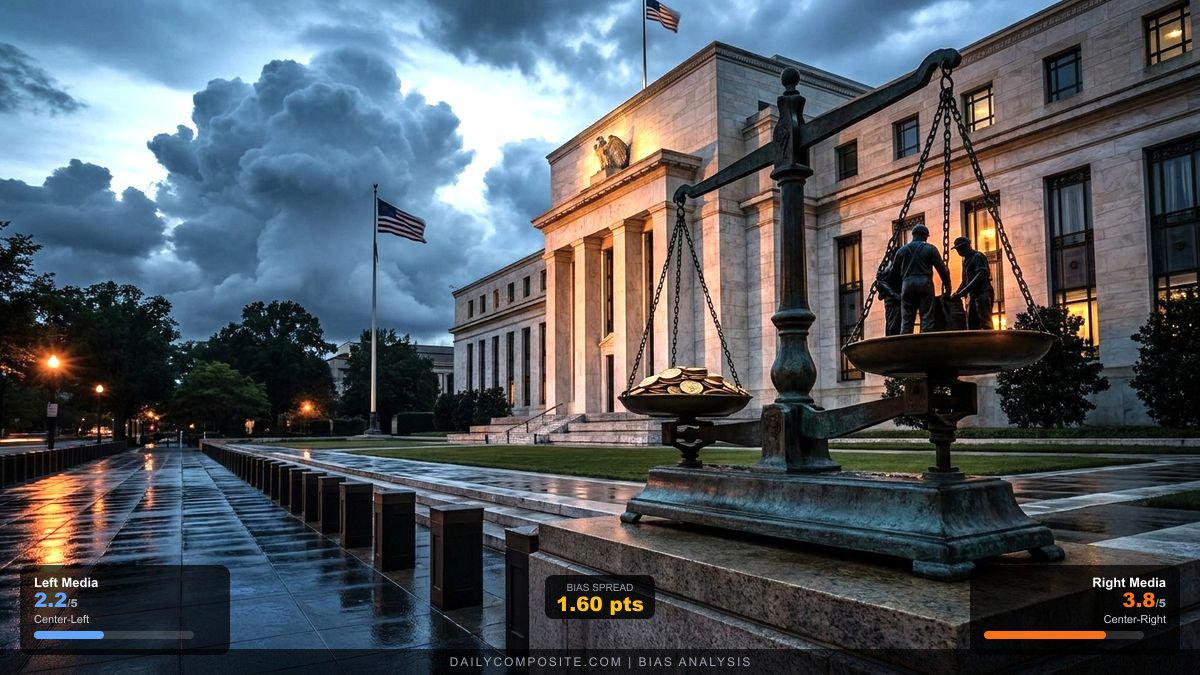
Left-leaning coverage framed the Warsh comments as an alarm bell for democratic institutions, leading with warnings from international economists and former Fed officials about the damage political interference could do to the dollar's reserve currency status.
Right-leaning coverage framed it as an overdue correction - the argument being that the Fed has operated as an unaccountable fourth branch of government for too long, that its pandemic-era money printing contributed directly to the inflation that crushed working-class Americans, and that Warsh's willingness to challenge its scope is a feature, not a bug.
Both framings are doing something real. The left-leaning version is more alert to the institutional risks. The right-leaning version is asking a genuinely important question about democratic accountability that the press usually ignores when a Democrat is in the White House.
The bias spread on this story is wide because the underlying tension - between institutional independence and democratic accountability - is one where the honest answer is "both concerns are valid." That's exactly the territory where media framing diverges hardest.
What the Dual Mandate Is Actually Carrying
The Fed's dual mandate - maximum employment and stable prices - looks simple. In practice, the two goals pull in opposite directions every time inflation runs hot. Raising rates to kill inflation puts people out of work. Cutting rates to support employment risks feeding inflation.
Every Fed decision is a value judgment about which of those two things matters more right now, and who bears the cost of being wrong. Warsh's intervention adds a third variable: who gets to make that value judgment. His answer - more executive input, less institutional autonomy - would shift the cost of those wrong calls directly onto voters, because voters would now have someone to blame.
That is either exactly how democracy is supposed to work, or exactly how central bank credibility gets destroyed. The answer depends entirely on whether you trust the executive making the calls.
Right now, the press is largely sorted by which way they answer that question. The bias score spread reflects that sorting.
Frequently Asked Questions
What is the Federal Reserve's dual mandate?
The Fed's dual mandate, established by Congress, requires the Federal Reserve to pursue two goals simultaneously: maximum employment and stable prices (low inflation). When these goals conflict - which they often do - the Fed must balance them through interest rate decisions and other monetary tools.
What did Kevin Warsh say about Fed independence?
Incoming Fed chair nominee Kevin Warsh suggested that Fed independence may not fully extend to the central bank's role in global financial crises. He argued that when the Fed acts as a global lender of last resort through mechanisms like dollar swap lines, it makes foreign policy decisions that should carry political accountability from the executive branch.
What are Federal Reserve dollar swap lines?
Dollar swap lines are agreements between the Fed and foreign central banks that allow those banks to borrow US dollars in a financial crisis, preventing dollar shortages from spiraling into global financial panic. The Fed deployed them in 2008, 2020, and other stress periods without requiring presidential approval. Warsh's comments question whether those decisions should require more executive input.
Why does Fed independence matter for inflation and unemployment?
Fed independence is meant to insulate interest rate decisions from short-term political pressure. Politicians typically prefer low rates (which boost growth and employment before elections) over high rates (which control inflation but slow growth). Without independence, the risk is that rates stay too low for too long, feeding inflation, with the cost falling on ordinary workers and savers.
How is the media covering Kevin Warsh and the Fed differently?
Left-leaning outlets are treating Warsh's comments as a warning sign for institutional stability, citing international economists and former Fed officials who say political interference could weaken the dollar's reserve currency status. Right-leaning outlets are framing the same comments as an overdue accountability check on an unelected institution that already operates with enormous unchecked power. DailyComposite tracks the bias spread across both sides daily.
Who is Kevin Warsh?
Kevin Warsh is a former Federal Reserve governor (2006-2011) and investment banker who served on President George W. Bush's National Economic Council. He is Trump's expected nominee to replace Jerome Powell as Fed chair. During his prior Fed tenure, he was known as a hawk on inflation and a skeptic of unconventional monetary policy, positions that align with the current administration's stated preferences.