
The Fall of Fortress Budapest: Orban's Defeat and the Shockwave Felt from Moscow to Mar-a-Lago
Hungarian voters ended sixteen years of Viktor Orban. The tremors will be felt in the Kremlin, in Brussels, on the front lines of Ukraine, and in a Trump White House that bet everything on the wrong horse.
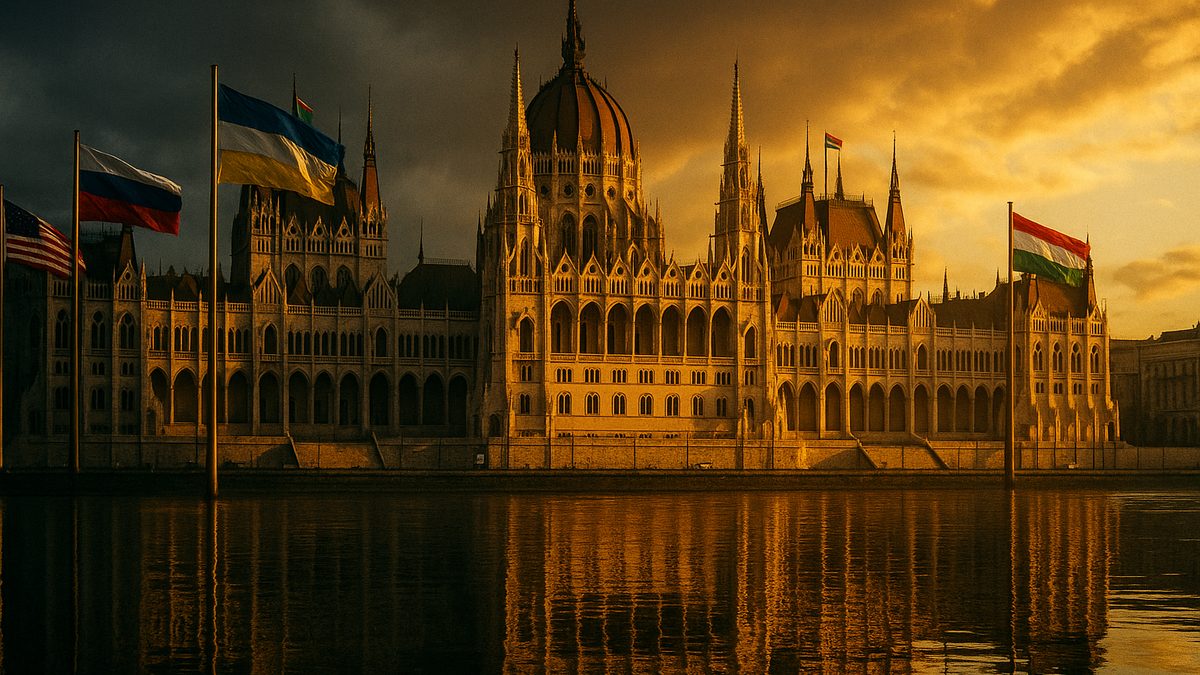
On a warm April Sunday in Budapest, Hungarian voters accomplished something that Vladimir Putin's war planners, the Kremlin's GRU operatives, and the Vice President of the United States could not prevent: they ended sixteen years of Viktor Orban.
The scale of the repudiation was staggering. With roughly half of votes counted, the opposition Tisza Party, led by Peter Magyar, a former Fidesz insider turned unlikely democratic standard-bearer, was on course to capture 68 percent of parliamentary seats against a mere 29 percent for Orban's once-dominant Fidesz alliance. Voter turnout surged to historic levels. Record queues formed outside polling stations in Budapest. The Hungarian people did not whisper their verdict. They roared it.
What happened in Hungary today is not merely a domestic story. It is a geopolitical earthquake whose tremors will be felt in the Kremlin's war rooms, in the corridors of Brussels, on the frozen front lines of Ukraine, and in the uneasy halls of a Trump White House that bet everything on the wrong horse.
The Man, the Machine, and the Myth
For sixteen consecutive years, Viktor Orban ruled Hungary through a system that scholars described in increasingly alarmed terms: an "illiberal democracy," a "hybrid regime of electoral autocracy," a state where citizens retained the theoretical right to vote but where the institutional architecture had been engineered to guarantee a single outcome.
Since returning to power in 2010, Orban and his Fidesz party methodically captured or dismantled every institution capable of checking executive power. The judiciary was packed with loyalists. The public broadcaster was shuttered. Private media networks fell into the hands of Fidesz-aligned business oligarchs. The Central European University was effectively expelled from Budapest. Freedom House reclassified Hungary from "Free" to "Partly Free." The European Parliament formally declared Hungary a "hybrid regime of electoral autocracy" in 2022, noting that while elections were held, democratic norms had been systematically hollowed out.
Beyond Hungary's borders, Orban had become something even more consequential: the avatar of a global movement. His brand of illiberal nationalism became the ideological template for authoritarian-adjacent politicians from Paris to Buenos Aires to Washington. Hungary hosted CPAC. Vance quoted Orban. Trump called him "a fantastic man." The Heritage Foundation cited Hungary's governance model favorably. Orban was not simply running a small Central European country. He was running the world's most successful laboratory for democratic backsliding, and the global right was taking careful notes.
Today, the lab blew up.
The Kremlin's Playbook
The degree to which Vladimir Putin's government invested in Orban's re-election cannot be overstated, and it tells us everything about why Hungary matters to Russia strategically.
In March 2026, the investigative outlet VSquare, citing multiple European national security sources, reported that Moscow had dispatched a three-person GRU team to the Russian Embassy in Budapest under diplomatic cover. The operation was reportedly overseen by Sergei Kiriyenko, Putin's First Deputy Chief of Staff and the architect of Russia's election interference apparatus. Western intelligence agencies independently corroborated the report's core findings, and The Washington Post subsequently authenticated further details.
The Kremlin-linked Social Design Agency, already under Western sanctions for running influence operations in the United States and Germany, drafted plans to flood Hungarian social media with pro-Orban messaging. The campaign deployed the "Doppelganger" tactic: fake clones of legitimate outlets like DW, Euronews, and even the Kyiv Independent, all carrying fabricated stories, including false claims of assassination attempts against Orban and manufactured Ukrainian "aggression." A bot network dubbed Matryoshka spread these narratives at scale across Facebook and TikTok.
The tactics escalated dramatically as election day approached. Serbian authorities discovered two backpacks containing plastic explosives near the TurkStream gas pipeline spur close to the Hungarian border. Orban immediately blamed Ukrainian sabotage, despite the fact that independent security analysts had publicly predicted precisely this kind of incident three days earlier, including the likely geographic location and the expected framing. Ethnic Hungarians in Ukraine's Transcarpathia region received mass threatening calls from spoofed Ukrainian phone numbers, calls subsequently traced by Ukraine's Security Service directly back to Russian territory.
Most audacious of all: The Washington Post, citing a document authenticated by a European intelligence service, revealed that Russia's Foreign Intelligence Service had considered staging a fake assassination attempt against Orban, dubbed "the Gamechanger," designed to rally his supporters in the final stretch of the campaign. The plan was only abandoned after The Post published its account, disrupting the operation.
The Kremlin knew exactly what it stood to lose. Today, it lost it anyway.
Vance in Budapest: When Washington Campaigns Abroad
Five days before Hungarian voters went to the polls, the Vice President of the United States boarded Air Force Two and flew to Budapest. It was not a diplomatic courtesy call. It was a campaign rally.
JD Vance's visit to Hungary was, by any honest accounting, one of the most extraordinary acts of overt foreign election interference by a senior American official in modern history. He stood before a stadium crowd and, over forty minutes, delivered a speech that left no ambiguity about its purpose.
Vance called Orban "one of the only true statesmen in Europe," an insult to every Western-aligned leader in London, Berlin, and Paris, delivered from a campaign stage in Budapest. He called the Trump-Orban alliance "the defense of Western civilization." He called on the crowd to "stand with Viktor Orban" and go to the polls on his behalf. He even called Trump mid-speech and put him on speakerphone, so the Hungarian audience could hear the American president declare: "I love that Viktor. He didn't allow people to storm your country."
Magyar's response was pointed and effective: "No foreign country may interfere in Hungarian elections. Hungarian history is not written in Washington, Moscow, or Brussels. It is written in Hungary's streets and squares."
The Vice President of the United States flew across the Atlantic to campaign for a foreign leader. That leader lost by nearly 40 percentage points.
What Orban's Loss Means for the United States
The domestic implications of Orban's defeat for American politics are significant, layered, and frankly underappreciated by most mainstream commentary.
First, it is a direct and humiliating rebuke to the Trump administration's foreign policy philosophy. The White House had gone all-in: Trump endorsed Orban in February, Rubio visited in February, Vance personally campaigned in April. All of it failed. The message Orban was supposed to send, that illiberal democracy is durable, popular, and self-perpetuating, has been repudiated by the very people it was supposed to govern.
Second, it delivers a critical stress test result to the broader right-wing international movement that the Trump administration has been cultivating. That network's most iconic figurehead just collapsed at the ballot box. The message to European far-right parties, and to worried American conservatives watching from home, is that this model is not bulletproof. Voters, even in rigged systems, can and do break through.
Third, Vance's Budapest trip now becomes a liability rather than a credential. In a 2028 presidential primary context, footage of the sitting Vice President of the United States standing on stage with a foreign strongman demanding his reelection, and losing, will be replayed endlessly. Mainstream conservatives in swing states are unlikely to find a story about American officials campaigning alongside a man now associated with Russian election interference to be a compelling argument for Vance's judgment.
Finally, the defeat removes one of the cleaner real-world arguments that illiberal democracy works. For years, Orban's Hungary was cited by American nationalists as evidence that a leader willing to reshape institutions aggressively enough could remain in power indefinitely while still holding elections. What Hungary proves instead is that even a sixteen-year incumbent who controls the media, the judiciary, the electoral commission, and the state resources, and who has the active support of both a major foreign intelligence service and the Vice President of the United States, can still be voted out when the people are sufficiently motivated.
A Seismic Shift for the European Union
For the European Union, Orban's departure is simultaneously a relief and a challenge. A relief because he has been, without question, the single most disruptive and damaging member state leader in the bloc's recent history. A challenge because the institutional damage runs deep, the transition will be complicated, and no one yet knows exactly who Peter Magyar really is.
Because EU foreign policy decisions require unanimity, a single veto from Budapest was sufficient to block critical decisions affecting 27 countries and 450 million people. Orban used that veto power as a geopolitical weapon: delaying sanctions on Russia, obstructing Ukraine's EU accession process, and, most recently and most damagingly, single-handedly blocking a 90 billion euro EU loan to Ukraine that had been agreed upon by all other member states and was essential to sustaining Kyiv's wartime finances.
Beyond the vetoes, Hungary's Foreign Minister was caught on leaked audio briefing his Russian counterpart Lavrov on the contents of confidential EU foreign ministers' meetings and offering to forward internal documents about Ukraine's accession process. These are not the acts of a difficult partner. They are the acts of a foreign intelligence asset operating from inside the European Union.
With Orban gone, the EU's immediate priority will be the Ukraine loan. Kyiv had been facing a critical budget gap in May, and the 90 billion euro package should move forward relatively quickly under a Magyar government. But caution is warranted. Magyar is not a European liberal in the classical mold. Real democratic restoration in Hungary could take years. Orban spent sixteen years embedding loyalists throughout the judiciary, prosecution service, regulatory bodies, Constitutional Court, and Budget Council.
Russia's Strategic Loss, and Ukraine's Fragile Opportunity
For Vladimir Putin, today's result in Budapest is a serious strategic setback, arguably the most significant he has suffered inside the Western alliance since the beginning of his full-scale invasion of Ukraine.
Hungary under Orban was not merely a friendly voice in European councils. It was a functioning Russian proxy, blocking sanctions, delaying aid, leaking intelligence, providing diplomatic cover, and maintaining energy dependence on Russian gas and oil that kept Moscow's revenues flowing. Budapest was the Kremlin's most reliable lever inside the institutions designed to counter Russian aggression. That lever has just been pulled out of the Kremlin's hands.
For Ukraine, the implications are potentially transformational. The immediate release of the EU loan could stabilize Kyiv's war financing for a significant period. The removal of Hungary's veto over EU accession discussions removes one of the most durable obstacles to Ukraine's long-term path toward European membership. But whatever relief Magyar's election provides on the financing and diplomatic fronts, it does not resolve the fundamental military equation on the ground.
What Hungary Taught the World Today
There is a tendency, in the aftermath of elections like this one, toward triumphalism. That triumphalism is premature, and it would be dishonest. Orban built his system carefully, over decades. His loyalists still fill Hungary's courts, media ownership still skews toward Fidesz-aligned oligarchs, and the constitutional architecture still contains multiple traps designed to frustrate any reformist government. Magyar faces an extraordinary governing challenge. Russia will adapt its influence operations. The global far-right will internalize the lessons and try again elsewhere.
But what Hungary has demonstrated today is something profound: that democratic accountability does not die simply because powerful people wish it dead. A government that controlled the media, the judiciary, the electoral commission, and the national narrative, and that had the active support of both Russian intelligence and the Vice President of the United States, still could not survive the accumulated judgment of its own citizens.
The Council on Foreign Relations framed the stakes precisely: a Magyar victory demonstrates "that Europeans, regardless of outside interference, will decide the future of their governments domestically." In a moment when the architecture of Western democracy is under sustained pressure from both internal populists and external authoritarian powers, Hungary has provided empirical evidence, messy, complicated, incomplete empirical evidence, that the pressure is not irresistible.
The long queue of voters outside Budapest polling stations this morning was not just a Hungarian story. It was a message, delivered in the most direct political language available to ordinary citizens, to every capital that has been watching this small country as a laboratory: the experiment has failed.
The fortress has fallen. What gets built in its place is now Hungary's, and the world's, most consequential question.