
The World Economy Was Almost Out of the Woods. Then the War Came.
A global economy that had survived a pandemic, a trade war, and years of stubborn inflation was finally finding its footing. What followed changed everything.
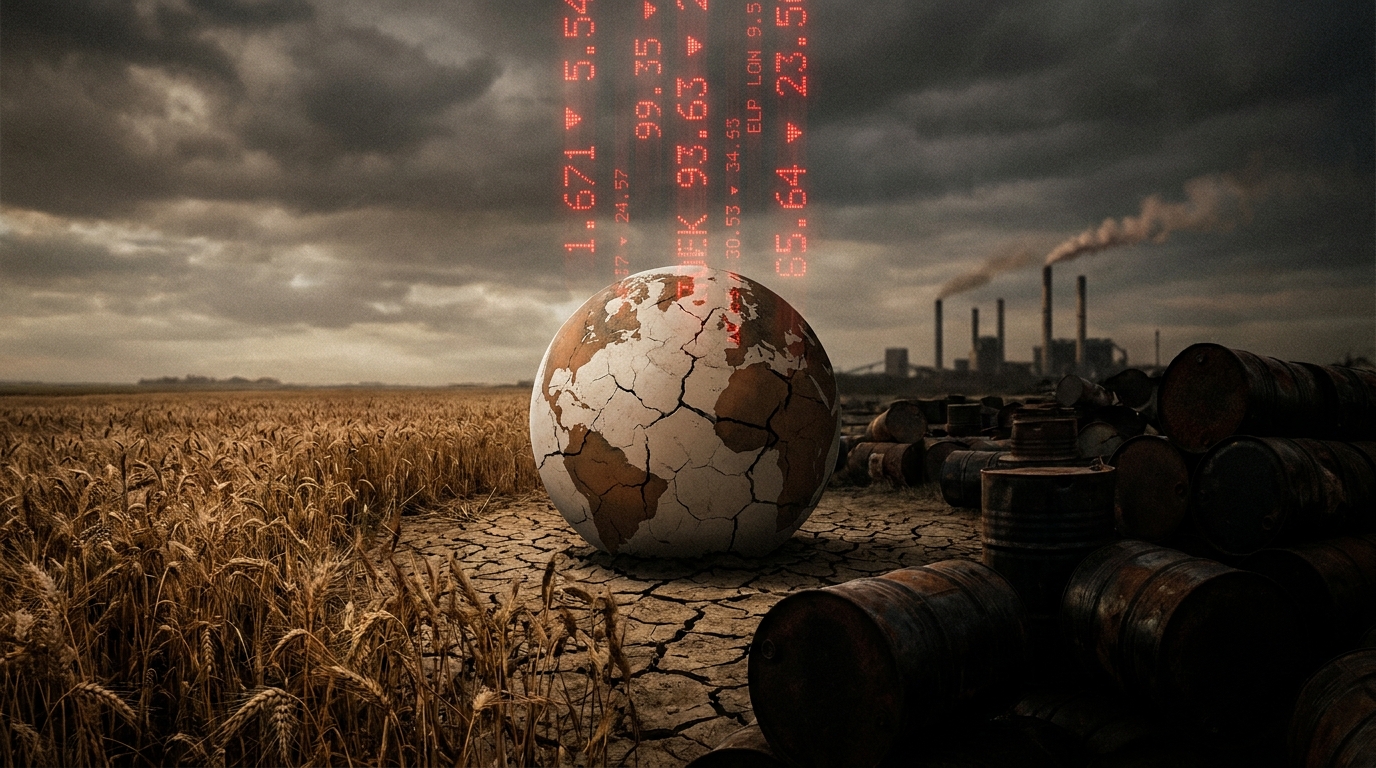
The Iran-US conflict that began on February 28, 2026 triggered the largest oil supply disruption in recorded history, cutting global growth forecasts from 3.4 percent to 3.1 percent, pushing Brent crude above $126 per barrel, and raising serious warnings of stagflation across Europe and Asia. Every day the Strait of Hormuz remains effectively closed, the damage compounds across oil markets, fertilizer supplies, and food prices that won't peak until late 2026 at the earliest.
Going into this year, there was cautious optimism in the air. Not the frothy kind that precedes a crash. The quiet, earned kind that comes after years of hard slogging. Inflation had cooled. Central banks had started easing. The IMF had penciled in global growth of 3.4 percent for the year. For the first time since the pandemic upended everything, the global economy looked like it might actually get back to something resembling normal.
Then, on February 28th, the United States and Israel launched military strikes against Iran.
Within days, the Strait of Hormuz, the narrow passage through which roughly a fifth of the world's seaborne oil trade flows every day, was effectively shut. And the world that had just started breathing again found itself holding its breath once more.
What the IMF's April 2026 Forecast Actually Shows
The IMF's April 2026 World Economic Outlook tells the story in cold figures: global growth is now projected at just 3.1 percent this year, with headline inflation rising modestly instead of continuing its steady decline. Three-tenths of a percentage point shaved from an earlier forecast sounds modest. In a $110 trillion global economy, it represents hundreds of billions in lost output, evaporated savings, and suspended investment. Behind those numbers are businesses that cannot get fuel, farmers who cannot get fertilizer, and families paying more for food.
How the Strait of Hormuz Closure Is Disrupting Global Oil Supply
The Strait of Hormuz is 21 miles wide at its narrowest point. For decades, that sliver of water between Iran and Oman has been the jugular vein of global energy supply. Before the war, roughly 20 million barrels of crude oil and petroleum products passed through it every day, along with the vast majority of Qatar's liquefied natural gas exports.
That flow has now been reduced to a trickle. The IEA's April 2026 Oil Market Report calls it the largest supply disruption in the history of the global oil market. By early April, shipments through the Strait had fallen to around 3.8 million barrels per day, down from more than 20 million in February. Oil producers across the Gulf had no choice but to curtail output as local storage filled to capacity and exports became impossible.
"The closure of the strait amounts to removing close to 20 percent of global oil supplies from the market." — Federal Reserve Bank of Dallas, March 2026
The consequences moved fast. Brent crude surpassed $100 a barrel in early March for the first time in four years, reaching $126 at its peak. Physical delivery prices climbed even higher, with North Sea Dated crude trading around $130 per barrel. U.S. government officials and Wall Street analysts are now openly modeling scenarios where prices hit $200 a barrel if the standoff holds. Analysts who track chokepoint disruptions estimate a structural shortage of roughly 7 to 12 million barrels per day, even after accounting for alternative pipeline routes and incremental production from Venezuela and other non-Gulf suppliers.
The Petrochemical Supply Chain Breakdown Nobody Is Talking About
The focus on crude prices, jarring as they are, risks obscuring a deeper dimension of this crisis. The Persian Gulf doesn't just export oil. The region is the world's largest producer and exporter of the petrochemical feedstocks that underpin modern manufacturing, packaging, agriculture, and medicine. That supply chain is now visibly fracturing.
Naphtha, the hydrocarbon feedstock transformed into plastics, synthetic fibers, and gasoline components, has seen demand destruction unlike anything the market has experienced in recent memory. The IEA's April report documents a drop of 1.8 million barrels per day in LPG, ethane, and naphtha flows alone. South Korea has imposed a five-month restriction on naphtha exports to protect its domestic petrochemical industry. China has halted sulfuric acid exports. Countries are beginning to hoard the chemical building blocks their economies depend on.
Refineries in Asia and the Middle East have cut processing runs by around 6 million barrels per day in April. Global crude throughput is expected to decline by 1 million barrels per day across 2026. The downstream effects on consumers will take months to fully materialize, but they are coming. The plastics in packaging, the synthetic materials in clothing, the resins in car parts — all draw from the same feedstock pool that is now under severe stress.
Why the Iran War Is a Fertilizer Crisis Too
The timing of this conflict, from an agricultural standpoint, could hardly be worse. Spring planting season in the Northern Hemisphere is underway. The Gulf region accounts for roughly 30 to 35 percent of global urea exports and 20 to 30 percent of ammonia exports, and its export routes have been severed.
Unlike oil, the fertilizer market has no internationally coordinated strategic reserves. When supply is disrupted, there is no buffer. Urea prices were already up 50 percent since the start of the war as of late March. Diammonium phosphate and other key fertilizers followed. Anhydrous ammonia, one of the most widely applied fertilizers in American corn farming, is up more than 20 percent this year.
The agricultural fallout doesn't arrive in one season. It compounds. Reduced fertilizer application this spring translates into lower corn and soybean yields in late summer and fall. Corn is the primary feedstock for U.S. beef, poultry, and dairy. Brazil, which relies on the Gulf for nearly half of its fertilizer supply and accounts for 60 percent of global soybean exports, faces serious yield risks. The Food Policy Institute in London has warned of food price increases extending well into 2027.
Oil Futures vs. Physical Prices: Why the Gap Tells the Real Story
One of the stranger features of this crisis has been the divergence between futures markets and physical markets. Futures prices for Brent crude have at times drifted back toward $97 per barrel as traders bet on a diplomatic resolution. Physical delivery prices (what actual buyers in Asia and Europe are paying for real barrels of crude) tell a completely different story, trading at $130 per barrel or more.
That $35 gap is not a market inefficiency. It is a scarcity premium. It reflects what happens when refineries in Japan, South Korea, India, and Southeast Asia scramble to replace locked-in Middle Eastern supply with anything available from Norway, Brazil, or West Africa. The bidding war for available barrels is real, and it is ongoing.
Asian demand for oil has already fallen by an estimated 2 million barrels per day as prices have forced demand destruction. Fuel shortages are being reported across Thailand, Pakistan, and parts of Australia. Carriers have cancelled flights across Southeast Asia. Pakistan asked cricket fans to watch games from home to conserve fuel.
Europe's Stagflation Risk Is Now Explicit
While Asia absorbed the first wave most acutely, Europe is bracing for what analysts describe as the medium-term reckoning. Shell has warned publicly that European fuel shortages could arrive as early as April. The European Central Bank has cautioned that a prolonged conflict will likely tip Germany and Italy into technical recession by end of 2026.
European chemical and steel manufacturers have already imposed surcharges of up to 30 percent on customers to offset surging electricity and feedstock costs. The ECB has warned explicitly of stagflation, a toxic combination of low growth and rising inflation that leaves central banks with no good options. Raise rates to fight inflation and you choke an already weakening economy. Cut rates to support growth and you let inflation run hotter.
Germany, with its energy-intensive industrial base and tight integration with Middle Eastern LNG supply chains, is particularly exposed. Italy faces a similar vulnerability. The German government's announcement of temporary fuel tax cuts illustrates the kind of reactive, improvised policy response that a genuine supply crisis forces.
Could the Iran War Cause a Global Recession in 2026?
The IMF has been careful to frame its 3.1 percent growth projection around an assumption that the conflict remains limited and that energy production normalizes by mid-year. The agency itself acknowledges this may prove too optimistic.
If the disruption extends through three quarters of 2026, the Dallas Fed's modeling suggests global GDP growth could fall by 1.3 percentage points. Combined with inflationary pressure from energy and food prices, that trajectory points toward stagflation of a severity the world has not faced since the 1970s. The parallels to the 1973 Arab oil embargo and the 1979 Iranian Revolution are grounded in structural mechanics, not rhetoric.
The IMF projects global headline inflation ticking up to 4.4 percent in 2026 under its reference scenario, a sharp deviation from the disinflation trend that had been the defining macro feature of the past two years. Central banks that had just begun cutting rates now face the prospect of reversing course precisely when economies are already weakening.
The Diplomatic Race Against Physical Limits
The U.S. naval blockade of Iranian ports, which took effect this morning, represents a dramatic escalation of economic pressure on Tehran. Vice President JD Vance described Iran's closure of the Strait of Hormuz as economic terrorism against the entire world. Whether the blockade accelerates or derails the diplomatic track remains the central question hanging over markets today.
U.S. officials confirmed this morning that the two sides are still communicating and that a second round of in-person talks remains active. Pakistan's Army Chief, General Asim Munir, spoke directly with President Trump to flag the blockade as an obstacle to further negotiations. China's Foreign Minister Wang Yi called on the international community to intensify peace efforts, warning that ceasefire momentum was extremely fragile.
The physical oil market doesn't wait for diplomacy. Inventories are being drawn down. Refineries are cutting runs. Fertilizer stockpiles are being depleted during the critical spring planting window. Every day the Strait remains effectively closed, global supply chains lose capacity that cannot be immediately restored even after a diplomatic breakthrough. The IEA has noted that even if the Strait reopened tomorrow, recovery in jet fuel supply alone could take months.
What Comes Next for the Global Economy
The world had spent three years digging out from the economic wreckage of the pandemic. It navigated a trade war, absorbed historic tariff shocks, and managed the inflation that followed an unprecedented flood of stimulus spending. The global economy demonstrated real resilience.
The Iran conflict has put all of that at risk. A 21-mile-wide waterway has proven, once again, that the integrated global economy rests on physical infrastructure that is far more vulnerable than financial markets tend to price in.
If the ceasefire holds and the Strait reopens, the damage will be significant but recoverable. If the conflict widens or drags into the second half of 2026, the world may be looking at a supply shock that reshapes energy markets, agricultural systems, and industrial supply chains for years. The diplomats have the next few weeks to prove that the physical clock ticking in oil storage facilities, fertilizer warehouses, and fuel depots across three continents can be outrun.
History suggests the odds are worse than markets currently believe.
Frequently Asked Questions
How has the Iran-US war affected global oil prices in 2026?
Brent crude surpassed $126 per barrel after the Strait of Hormuz closure, up from around $70-80 before the conflict. Physical delivery prices have traded even higher, around $130 per barrel. Analysts are modeling scenarios where prices reach $200 per barrel if the standoff continues through mid-2026.
How much oil passes through the Strait of Hormuz?
Before the conflict, roughly 20 million barrels of crude oil and petroleum products passed through the Strait every day, approximately 20 percent of global seaborne oil supply. By early April 2026, that flow had fallen to around 3.8 million barrels per day.
Will the Iran war cause a global recession?
The IMF has cut its 2026 global growth forecast from 3.4 percent to 3.1 percent. If the disruption extends through three quarters of 2026, the Dallas Fed estimates global GDP could fall by an additional 1.3 percentage points. Europe is the most exposed region, with Germany and Italy at risk of technical recession by year-end.
Why is the Iran war causing food prices to rise?
The Gulf region supplies 30-35 percent of global urea exports and 20-30 percent of global ammonia exports, key fertilizers used in corn, soybean, and wheat production. With those export routes severed during spring planting season, reduced crop yields in late 2026 are expected to push food prices higher well into 2027.
What is stagflation and why is it a risk now?
Stagflation is the combination of low economic growth and rising inflation. It is particularly difficult for central banks to manage because the tools used to fight inflation (raising interest rates) also slow growth. The ECB has explicitly warned of stagflation risk for Europe, and the IMF projects global headline inflation rising to 4.4 percent in 2026 even as growth slows.
What is the difference between oil futures prices and physical oil prices right now?
Futures prices for Brent crude have at times traded around $97 per barrel, reflecting trader expectations of an eventual diplomatic resolution. Physical delivery prices have traded at $130 per barrel or more. The roughly $35 gap is a scarcity premium reflecting the scramble by Asian and European refiners to source oil outside the Middle East.