
The Red Wall Didn't Crack. It Collapsed.
Reform UK swept Labour's northern heartlands Thursday. Forty-seven years of council control ended overnight. Here's what actually happened, and why the media can't agree on what it means.
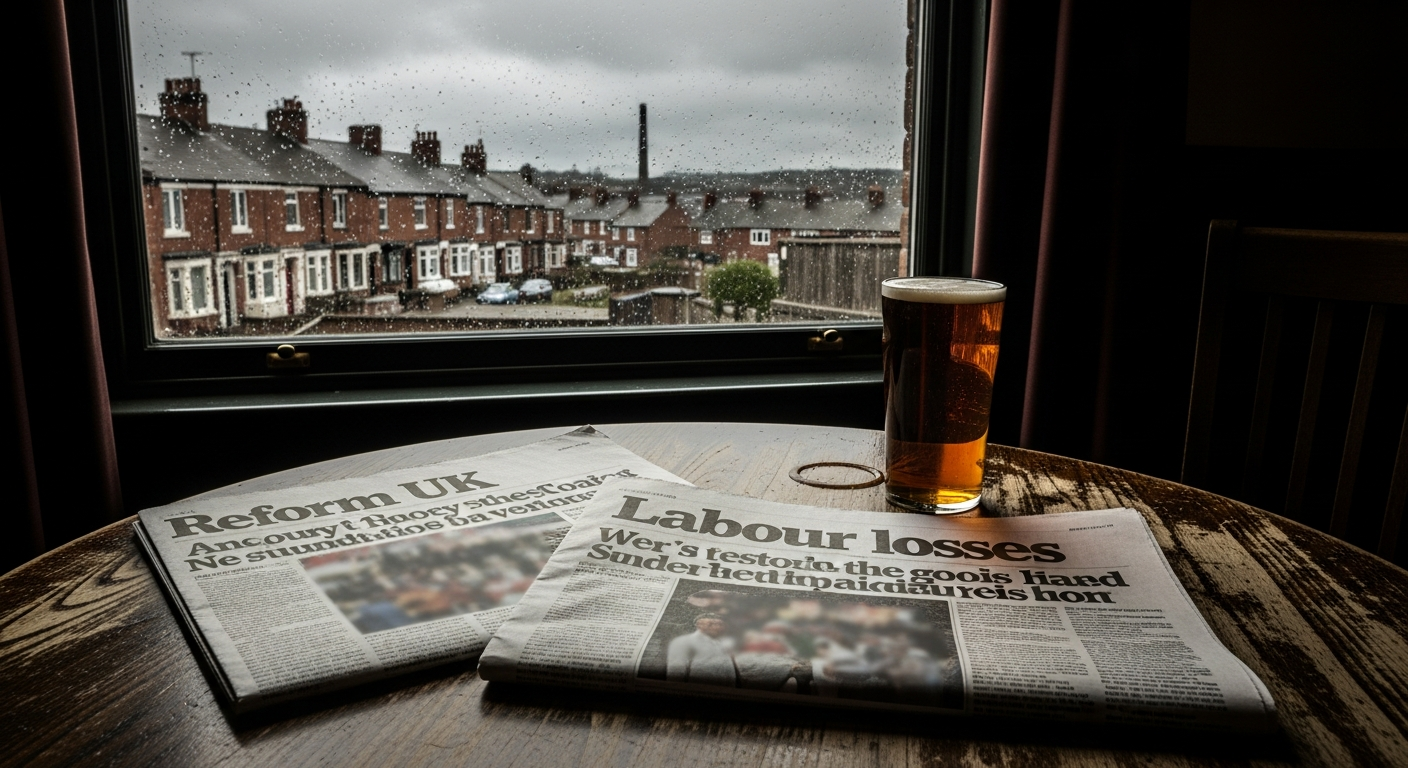
Forty-seven years. That's how long Labour ran Tameside. The mill towns, the terraced streets, the generations of councillors. All of it ended Thursday night when Reform UK walked in and took the council.
In Wigan and Leigh — two former mining towns in the northwest of England — Reform won 24 of 25 available seats. In Greater Manchester, in the Liverpool City Region, in ex-industrial belts that once defined the Labour Party's reason for existing, the results came in looking the same way: red going blue-purple, Labour losing, Reform gaining.
By midday Friday, Reform had picked up 339 council seats. Labour had lost more than 208. Prime Minister Keir Starmer stood in West London and said there was "no sugarcoating it."
There wasn't.
The Red Wall Isn't Crumbling. It Already Fell.
Political commentators have talked about the "Red Wall" for years as if it were still standing, just cracked. The local election results this week make clear it's not a crack. It's a collapse.
The Red Wall — that band of former industrial constituencies running through the North of England and the Midlands — started breaking in 2019 when Boris Johnson won Brexit-focused seats that Labour had held for decades. Those voters were supposed to come back. They haven't. They've moved further right, and this time they have somewhere specific to go.
Nigel Farage has spent thirty years building toward this moment. He's failed at parliamentary elections seven times. But Reform isn't running a parliamentary campaign right now — it's running a cultural one. And in local councils, where turnout is low, identity is high, and anti-establishment sentiment travels fast, that strategy works.
What Reform Actually Won
The results need context before they become a verdict.
Local elections in England are decided by voters who often stay home in general elections. Turnout in many of these councils runs below 30%. Reform's surge is real, but it's happening in a low-participation environment where an energized minority can dominate. The 2024 general election showed the gap clearly: Reform got 14% of the vote and won only five parliamentary seats under first-past-the-post.
Still, the direction is unmistakable. Reform took its first council outright, Newcastle-under-Lyme in Staffordshire, flipping it from the Conservatives. It made gains in London's outer boroughs. It ran competitive races in places that, five years ago, wouldn't have considered a Farage-aligned party remotely viable.
This is what a party looks like when it stops being a protest vote and starts being a governing one, at least at the local level.
The Media Framing Split
Here's where DailyComposite's core purpose applies directly. The story you read about these results depends entirely on where you read it.
The right-leaning press frames this as democratic accountability. Working-class communities rejected a Labour Party that stopped representing them. A legitimate political realignment. Farage delivering what voters actually want on immigration and cost of living. The framing is triumphant, almost vindicating.
The left-leaning press frames it as a warning about creeping authoritarianism. Farage's opportunism filling a vacuum left by Labour's failure to deliver, a protest vote that will produce worse outcomes for the communities that cast it. The framing is alarmed, occasionally condescending.
Both frames contain real observations. Neither tells the whole story. The voters who backed Reform in Wigan aren't ideologues. They're people who watched their town decline across multiple governments from both parties, and they're choosing the option that sounds loudest about it. That's not an endorsement of every Reform policy. It's a message about the other parties.
What Starmer Does Now
Keir Starmer won a historic parliamentary majority less than a year ago. He now trails Reform UK in national opinion polls. That's a steep fall by any historical standard.
Starmer said he would not step down. His instinct is to stay the course: deliver on the economic plan, take the short-term pain, and argue that governing is harder than it looks from the outside. That may be correct as a policy matter. It is not working as a political matter.
The cost-of-living crisis that drove these results isn't going away on its own. An Ipsos survey conducted ahead of the elections identified it as the number one concern for voters across every region. Reform gives simple answers to complex problems, which is politically powerful precisely because complex answers don't fit on a campaign leaflet.
Labour's left flank, the Greens and the pro-Palestine independents who cost it seats in 2024, is also still there, gaining in some areas even as it underperformed the pre-election hype. Starmer is being squeezed from both directions, which is the hardest political position to hold.
The Global Pattern
What's happening in the UK isn't unique to the UK. The same voters who backed Trump in 2016 — white working-class communities that felt left behind by globalization and ignored by centrist parties — showed up in the Brexit vote that same year. They're now showing up for Reform.
The pattern across Western democracies is consistent enough to be a structural phenomenon rather than a series of coincidences: when mainstream parties — left or right — fail to deliver material improvements for working-class communities, those communities eventually move to parties that speak their language, even if the policies don't match the rhetoric.
Reform's policy platform, examined closely, would likely worsen the economic conditions in the communities that are voting for it. Cuts to public services hit these towns hardest. Reduced immigration policy in agricultural and care sectors creates labor shortfalls. But that analysis requires voters to trust that the mainstream parties making those arguments would have done better — and that trust is gone.
Farage understands something that centrist politicians keep relearning: politics is emotional before it is rational, and anger is the most reliable mobilizing emotion there is.
Frequently Asked Questions
What happened in the 2026 UK local elections?
Reform UK made significant gains across England, winning 339 council seats and taking control of several councils including Newcastle-under-Lyme. Labour lost more than 208 councillors, with major defeats in traditional strongholds like Tameside — where Reform ended 47 years of Labour control — and Wigan, where Reform won 24 of 25 available seats.
What is the Red Wall in UK politics?
The Red Wall refers to a band of former industrial constituencies in the North of England and the Midlands that historically voted Labour for generations. These communities — built around mining, manufacturing, and steel — began breaking from Labour in 2019 and have continued to shift toward Brexit-aligned and now Reform UK candidates.
Why is Reform UK winning working-class Labour voters?
Reform UK is winning in traditional Labour areas for the same reasons populist parties gain traction anywhere: a sense of economic abandonment, frustration with political elites from both mainstream parties, and simple answers to complex problems. The number one concern for voters ahead of these elections was cost of living, and Reform speaks to that anger more directly than Labour's governing message.
Will Keir Starmer resign after the 2026 local elections?
No. Starmer said explicitly he would not step down, stating: "Days like this don't weaken my resolve to deliver the change that I promised." He took responsibility for the results while signaling he intends to stay the course on Labour's economic program.
Can Reform UK win a general election?
Not easily under the current first-past-the-post system. In 2024, Reform got 14% of the national vote and won only five parliamentary seats. Local elections — with lower turnout and more concentrated support — are better terrain for Reform than general elections. A parliamentary majority would require either a change to the voting system or a dramatic collapse of both Labour and Conservative support simultaneously.
How does UK media cover Reform UK differently?
Right-leaning outlets tend to frame Reform's rise as a legitimate democratic revolt — working-class communities demanding accountability. Left-leaning outlets tend to frame it as dangerous populism filling a vacuum. Both capture something true. DailyComposite tracks this divergence across outlets: the same vote total reads as a mandate in one outlet and a warning in another.