
Tortoise Economy or Ticking Clock?
GDP is growing. Inflation won't quit. The Fed just fractured 8-4. The right and left are using the same data to tell opposite stories. Here's what both are missing.
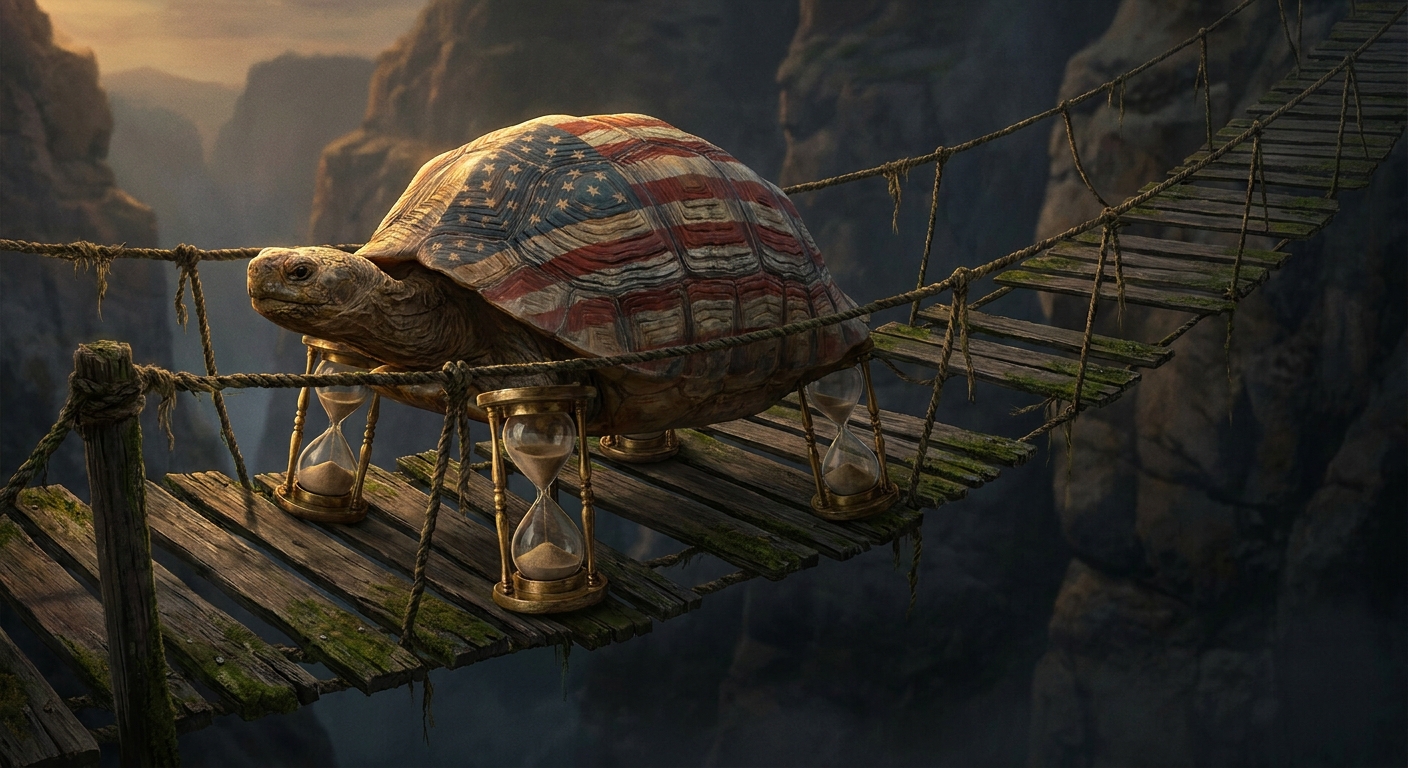
The economy is growing. Inflation won't go away. The Fed just fractured. And depending on which outlet you read, America is either a resilient giant powering through adversity or a debt-laden country about to run out of runway.
Both sides are using the same numbers. They're just telling completely different stories.
What the Data Actually Says
GDP grew at 2.1% in Q1 2026. That's not spectacular, but it's growth, and it marks the ninth consecutive quarter of expansion. Unemployment sits at 4.1%. Consumer spending, while softening, hasn't collapsed. By the headline metrics, the economy is still moving forward.
The problem is what's underneath those numbers.
Inflation came in at 3.2% for March, above the Fed's 2% target for the 26th consecutive month. Core PCE, the measure the Fed watches most closely, is at 2.9%. The Iran war has pushed Brent crude past $106 a barrel, which feeds into transportation, manufacturing, and food costs in ways that don't show up immediately in the headline CPI print but will.
The federal deficit is running at $2.3 trillion annualized. The debt-to-GDP ratio crossed 130% in February. Interest payments on the national debt now exceed defense spending. These are not contested figures. What is contested is whether they matter right now, matter later, or are being weaponized by one side to score political points.
The Fed Just Cracked
Wednesday's FOMC meeting produced the most dissents since 1992. Four members voted against holding rates steady, not because they wanted to cut, but because they wanted to hike. The 8-4 vote is the institutional version of a stress fracture. The Fed has spent three decades carefully managing the perception of consensus. That consensus is gone.
The split reflects a genuine disagreement about what the economy is doing. The majority sees growth softening under the weight of tariffs and the Iran war premium and wants to wait before tightening further. The minority sees sticky inflation as the dominant threat and thinks waiting is itself a policy error.
Both positions are defensible. That's what makes the fracture meaningful.
How the Right Is Telling This Story
Right-leaning outlets are leading with the growth numbers. GDP expansion. Low unemployment. A stock market that, despite volatility, is still well above its 2024 lows. The argument is that Trump's economic policies, including deregulation, energy production, and tariff leverage, are working. Inflation, in this framing, is a temporary artifact of supply chain disruption and war-driven energy costs, not a structural problem.
The Fed dissents are covered as a sign that some members are appropriately hawkish and that the institution is doing its job. Powell's final meeting is a transition moment, not a crisis of confidence.
How the Left Is Telling This Story
Left-leaning outlets are leading with the same data and reaching the opposite conclusion. Inflation at 3.2% after two-plus years of above-target readings is a policy failure, not a temporary blip. The deficit is structural, not cyclical. The interest payment burden is a long-term drag that compounds with every month rates stay elevated.
The Fed fracture, in this framing, is a sign of institutional stress: a central bank that has lost its ability to act decisively because political pressure has made every decision contested. Powell's exit isn't a transition. It's an expulsion. And Kevin Warsh's likely confirmation signals that the next Fed chair will be more accommodating to White House preferences.
What Both Sides Are Missing
The tortoise economy argument, slow but forward, only holds if the bridge holds. And the bridge has some problems.
The Iran war's economic cost is still being underpriced. Military operations in the Strait of Hormuz are expensive. The defense supplemental passed in February added $87 billion in spending that wasn't in any baseline projection. That money has to come from somewhere: more debt, higher taxes, or spending cuts that haven't materialized.
The food commodity story is barely being covered. While oil dominates the Iran war economic narrative, wheat futures are up 18% since the war began. Palm oil is up 22%. Iran is a significant agricultural exporter, and the war's disruption to regional shipping affects food supply chains that have nothing to do with petroleum. The inflation that shows up in grocery stores six months from now traces back to decisions being made right now. Neither side's economic story accounts for it.
The Real Question
The economy is a tortoise crossing a rope bridge. It's moving. The hourglasses are running. Whether the bridge holds depends on variables that neither political side wants to acknowledge are outside their control: the duration of the Iran war, the trajectory of global food prices, the Fed's ability to hold the line on inflation without triggering a recession.
The right says the tortoise is fine. The left says the bridge is rotting. They're both partially correct. Neither is giving you the full picture.
Frequently Asked Questions
Is the US economy in a recession in 2026?
No. GDP grew 2.1% in Q1 2026, marking nine consecutive quarters of expansion. Unemployment is at 4.1%. However, growth is slowing, inflation remains above the Fed's 2% target, and the deficit is at historically elevated levels.
Why did the Fed split 8-4 at the April 2026 FOMC meeting?
Four members dissented in favor of a rate hike, arguing that inflation at 3.2% requires tighter policy. The majority voted to hold, concerned that the economy is already slowing under the weight of tariffs and the Iran war energy premium. It was the most dissents at a single meeting since 1992.
How is the Iran war affecting the US economy?
Directly through energy prices, with Brent crude above $106 adding to transportation, manufacturing, and heating costs. Indirectly through food commodity prices (wheat and palm oil up 18-22%), defense spending ($87B supplemental), and reduced trade in the region.
Is inflation coming down in 2026?
Slowly and unevenly. Core PCE is at 2.9%, headline CPI at 3.2%. The Fed's 2% target has not been hit in over two years. The Iran war energy premium and rising food commodities create upside inflation risk heading into summer.
What happens to the economy if the Fed raises rates?
Higher rates slow growth and reduce inflation, but also increase the cost of servicing the national debt, already the largest line item in the federal budget. With the debt-to-GDP ratio at 130%, rate hikes have more severe fiscal consequences than in previous cycles.