The Maps Are Illegal. The Elections Happen Anyway.
Courts keep finding that Republican redistricting maps dilute Black voting power. States keep running elections under those maps while they appeal. That delay is not a side effect of the litigation. It is the point.
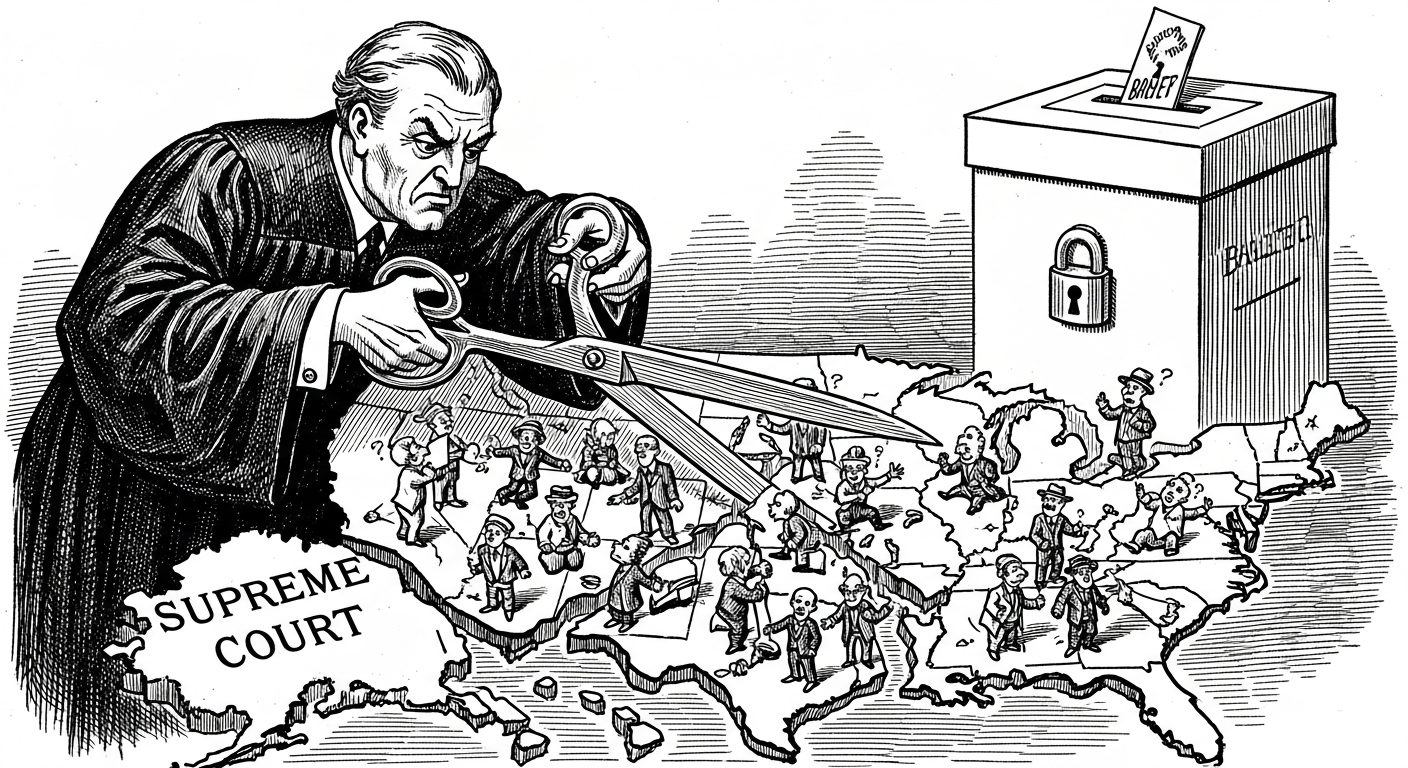
The Supreme Court this week halted a federal court order requiring Alabama to use a congressional map with two majority-Black districts. Virginia Democrats are asking the court to restore a voter-approved redistricting plan that Republican legislators replaced with maps that reduce minority representation. The pattern across multiple states is the same: Republican-drawn maps eliminating or weakening majority-Black districts, federal courts ordering corrections, and SCOTUS stepping in to pause or reverse those corrections.
This is the Voting Rights Act in 2026. Or what remains of it.
What the Court Has Done
The Voting Rights Act of 1965 was designed to prevent exactly this. Section 2 prohibits voting practices or procedures that discriminate based on race. For decades, it was used to challenge congressional maps that packed or cracked Black voters to dilute their electoral influence.
In 2013, the Supreme Court gutted Section 5 in Shelby County v. Holder, ending the preclearance requirement that forced states with histories of discrimination to get federal approval before changing voting laws. Justice Ruth Bader Ginsburg's dissent called it "throwing away your umbrella in a rainstorm because you are not getting wet."
The rain came fast. Within hours of the Shelby ruling, several states moved to enact voting restrictions that preclearance had previously blocked. Redistricting maps followed.
In 2023, Allen v. Milligan appeared to be a victory: the court ruled 5-4 that Alabama's congressional map diluted Black voting power in violation of Section 2 and ordered a second majority-Black district drawn. Alabama's Republican legislature responded by drawing a map that still failed to create the required district. The court found Alabama in noncompliance. This week, SCOTUS halted that remedial order while the case continues.
The Alabama case has company. Virginia's Republican legislature replaced a voter-approved redistricting commission's maps with its own. Virginia Democrats have now asked the Supreme Court to restore the commission maps. Tennessee has faced similar challenges over maps that consolidate Nashville's Black voters across multiple districts, diluting their representation in each.
How the Press Frames It
Left-leaning outlets frame this as the systematic dismantling of voting rights protections. The argument runs that a conservative court is providing legal cover for Republican-controlled legislatures to draw maps that reduce Black political power, that the stays and procedural maneuvers amount to running out the clock on electoral cycles, and that the practical effect is the suppression of minority representation regardless of what the final legal ruling says. The framing emphasizes racial justice, democratic backsliding, and the gap between legal victories and real-world impact.
Right-leaning outlets frame this as a dispute over the proper legal standard for race-conscious redistricting. The argument runs that drawing districts specifically to guarantee racial outcomes raises equal protection concerns, that the court is correctly applying a neutral legal standard, and that forcing states to create majority-minority districts is itself a form of racial sorting that violates the Constitution's colorblind ideal. The framing emphasizes judicial restraint, equal protection, and the limits of race-based remedies.
Both frames reflect genuine legal arguments that have been contested in courts for decades. What they obscure is the on-the-ground reality: the procedural mechanisms available to states with bad maps have consistently extended the life of those maps through multiple election cycles, meaning that even legal losses often produce no practical remedy before the next redistricting round.
The Clock Is the Strategy
This is the part that gets underreported. Redistricting litigation moves slowly. A state draws a map, plaintiffs sue, courts rule, states appeal, the Supreme Court weighs in. That cycle takes years. Congressional elections happen every two years. The math is straightforward: a state can draw an illegal map, lose in court, draw another map that also fails the legal standard, lose again, and by the time a compliant map is actually used in an election, an entire redistricting cycle has passed.
Alabama did this. After Allen v. Milligan, the state drew a map the district court found still violated Section 2. While that noncompliance ruling was being appealed, elections continued under the original illegal map. The Supreme Court's stay this week means they will likely continue under a map federal courts have found unlawful.
This is not a bug in the system. For legislators who benefit from the illegal maps, it is the system working as intended.
What "Gutting" Actually Looks Like
Calling these rulings a "gutting" of voting rights is left-press shorthand that is accurate in effect but imprecise in mechanism. The court has not ruled that Black voters can be discriminated against. It has, over a series of decisions, narrowed the tools available to challenge discrimination, raised the evidentiary bar for proving it, and provided procedural off-ramps that delay remedies past their useful electoral life.
The right-press counter — that this is neutral legal interpretation protecting against racial sorting — runs into the same precision problem. Drawing a district to concentrate Black voters is not the same legal act as drawing a district to crack and dilute Black voters, even if both involve race as a variable. The Voting Rights Act was passed specifically because race-neutral legal standards produced racially discriminatory outcomes in states with a documented history of doing exactly that.
Both sides are arguing about the instrument. The voters whose representation has been diluted are living with the results.
Why This Matters Through 2026
Midterm elections are coming. The districts being drawn and litigated now will determine which party controls the House. Several of the contested maps are in states where a single additional majority-Black district could flip a seat. The legal fights are abstract. The political stakes are concrete.
DailyComposite tracks exactly the framing divergence this story produces. The same SCOTUS ruling reads as "the court protects neutral redistricting principles" in one outlet and "the court guts minority voting rights" in another. Both outlets are covering the same ruling. The gap between those frames is where the actual debate about American democracy is happening.
Frequently Asked Questions
What did the Supreme Court rule on voting rights in 2026?
The Supreme Court halted a federal court order requiring Alabama to use a congressional map with two majority-Black districts, allowing elections to continue under a map lower courts found violated the Voting Rights Act. The court is also considering Virginia's redistricting dispute, where Republican legislators replaced a voter-approved map with one that reduces minority representation.
What is the Voting Rights Act and how has it been weakened?
The Voting Rights Act of 1965 prohibits voting practices that discriminate based on race. Its strongest enforcement tool, Section 5 preclearance, required states with histories of discrimination to get federal approval before changing voting laws. The Supreme Court eliminated preclearance in Shelby County v. Holder (2013). Since then, courts have also raised the evidentiary standard for Section 2 claims, making it harder to challenge discriminatory maps.
What is gerrymandering and how does it affect Black voters?
Gerrymandering is the drawing of electoral district lines to benefit a particular party or group. Racial gerrymandering against Black voters typically takes two forms: packing (concentrating Black voters into one district to limit their influence elsewhere) or cracking (splitting Black communities across multiple districts so they lack a majority in any). Both dilute Black political power even when the affected communities represent a significant share of a state's population.
What happened in Allen v. Milligan?
In Allen v. Milligan (2023), the Supreme Court ruled 5-4 that Alabama's congressional map violated Section 2 of the Voting Rights Act by diluting Black voting power. The court ordered Alabama to draw a second majority-Black district. Alabama's legislature drew a replacement map that courts again found noncompliant. In May 2026, SCOTUS halted the order enforcing that noncompliance ruling while the case continues.
Why does redistricting litigation take so long?
Redistricting cases move through district courts, appeals courts, and the Supreme Court over years. Congressional elections occur every two years. This mismatch means states can benefit from illegal maps through multiple election cycles before a compliant map is actually used. Critics argue this delay is itself a form of voter suppression, since the practical harm to minority voters occurs regardless of the eventual legal outcome.
How does media bias affect coverage of voting rights cases?
Significantly. Left-leaning outlets tend to frame these rulings as the deliberate dismantling of minority voting protections by a partisan court. Right-leaning outlets tend to frame them as the court correctly applying race-neutral constitutional principles against racial sorting. Both frames contain real legal arguments. DailyComposite scores the divergence between these framings daily, tracking how the same ruling is presented across the political spectrum.