
The Method Behind the Clayton Reversal
Blowing up his own bipartisan nominee looks like self-sabotage. Read the incentives closely and a different picture emerges, one in which the chaos is the strategy.
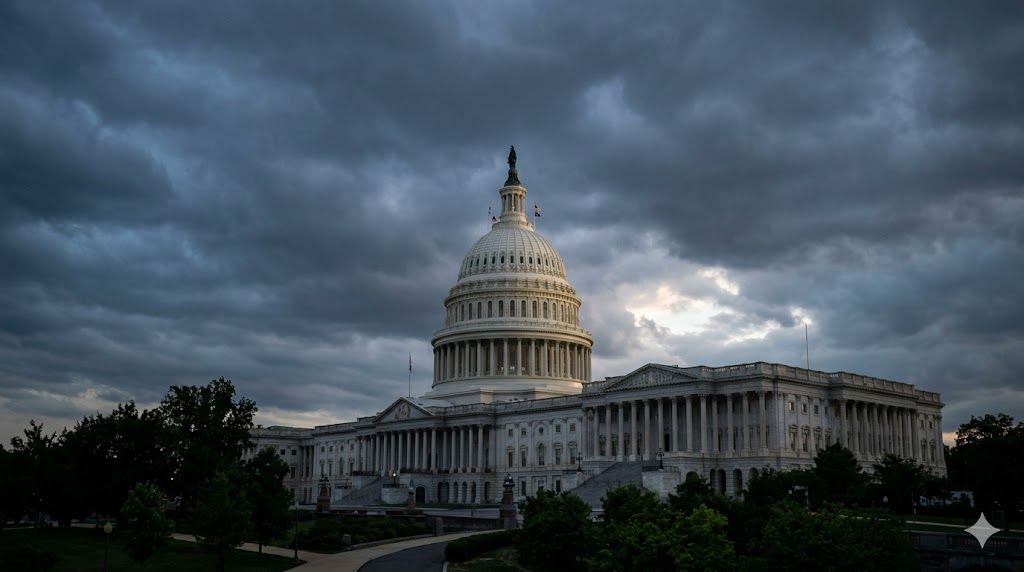
Sometime before four in the morning Eastern, from a gilded summit hall in Évian-les-Bains, the President of the United States reached across an ocean and dismantled the confirmation of the man he had personally chosen to run American intelligence. The Truth Social post that did it ran long, looped through three separate grievances, and ended, as these things always do, with a courtesy: "Thank you for your attention to this matter." Hours later, a Senate hearing that had been fast-tracked for this very morning was gone.
The easy verdict wrote itself before the sun came up. Here was a president torpedoing his own nominee, embarrassing the Republicans who had lined up to praise the pick, and stranding a surveillance authority that the national security establishment of both parties considers essential. Self-sabotage, the headlines said. Dysfunction. Chaos coming from the White House itself, in the words of the Senate Intelligence Committee's top Democrat.
All of that is true on the surface. But "self-sabotage" is a diagnosis that requires the actor to be working against his own interests, and that is precisely the assumption worth interrogating. What if the wreckage is not a malfunction? What if, judged against what this president has actually said he wants, the morning's demolition was the most rational move on the board?
The nominee nobody opposed
Start with how unusual the target was. Jay Clayton is not a controversial figure. He chaired the Securities and Exchange Commission during Trump's first term, came up through the white-shoe ranks of Sullivan & Cromwell, and has spent the last fourteen months as the United States Attorney for the Southern District of New York, one of the most coveted prosecutorial seats in the country. His office oversaw the unsealing of the Epstein and Maxwell records and the prosecution of Venezuela's Nicolás Maduro on drug-trafficking charges.
The day before the reversal, the White House published a victory-lap press release stacking up endorsements: Thune, Cotton, Graham, McConnell, Lankford, Tillis, Scott, a parade of Republicans calling him an "excellent choice." Tellingly, two Democrats joined in. Senator Mark Warner called him "a capable public servant" he had known and respected for years. Representative Jim Himes said he had known Clayton for decades and urged a quick confirmation. This was, in other words, a nominee with a clear runway in a chamber where almost nothing flies. The committee was prepared to vote as soon as the next day. The plan was to have him sworn in by June 19.
You do not accidentally derail a confirmation like that. Which means the question is not how the President fumbled it, but what he gained by stopping it.
Three demands, one lever
The pre-dawn post braided together three separate asks. He would not move Clayton out of the Manhattan U.S. Attorney's office until a successor, Jamie McDonald, was confirmed to replace him. He would not approve renewal of the lapsed surveillance authority, Section 702 of the Foreign Intelligence Surveillance Act, unless it was bolted to the SAVE America Act, his stalled bill requiring proof of citizenship to vote. And in the meantime, his acting director of national intelligence, housing official Bill Pulte, would simply remain in place.
Read as a tantrum, it scans as incoherent. Read as leverage, it is almost elegant. Each demand uses the same lever, the vacancy at the top of the intelligence community, to pry loose something the President could not otherwise get. The Clayton nomination was the one thing everyone in Washington agreed should move fast. By freezing it, Trump converted the capital's rare consensus into a hostage.
Consider the SAVE America Act on its own merits as legislation. It passed the House and died in the Senate, where it needs sixty votes and does not have them. A recent attempt to attach it to a border-funding bill failed 48 to 50, short even of a simple majority, with four Republicans defecting. By every ordinary measure that bill is finished for this Congress. The only way to revive a dead bill is to chain it to a living one, and a lapsed surveillance authority that the intelligence agencies are desperate to restore is about as alive as legislation gets. Senator Kevin Cramer, a Republican, said the quiet part plainly: the two do not go together naturally, but the President "wants to attach to something that's going to pass."
That is not the logic of a man who has lost the thread. That is the logic of a man who has correctly identified the only remaining vehicle for a priority he refuses to abandon.
The Pulte question
If the surveillance gambit explains the timing, Bill Pulte explains the stakes. And here the official story and the revealed preference pull in opposite directions.
Pulte was the original choice for acting director, and the choice that started this whole chain of events. He runs the Federal Housing Finance Agency. He has no national security background. What he does have is a record as one of the administration's most aggressive enforcers against the President's perceived enemies. He cheered the pressure campaign to force out Federal Reserve chair Jerome Powell. He used his platform to accuse a roster of Trump adversaries of mortgage fraud, among them Fed governor Lisa Cook, New York Attorney General Letitia James, and Senator Adam Schiff. Each denied wrongdoing.
The bipartisan revolt against putting that man in charge of eighteen intelligence agencies is what forced the President to reach for Clayton in the first place. Senator Warner, on national television, said heads of the intelligence community had told him they were terrified of showing Pulte information, and that foreign governments had registered alarm. So the obvious reading is that Clayton was the cleanup, the respectable fix for an indefensible first pick.
But watch where the President's own words point. He told the Wall Street Journal he hopes to see Pulte declassify documents related to the 2020 election and shrink the agency. Those are not the aspirations of someone settling for a placeholder. They describe a job, and a job-holder, chosen for loyalty and appetite rather than for the apolitical stewardship the role is supposed to demand. By stalling Clayton, the President does not merely delay a confirmation. He extends the tenure of the man he actually wants in the chair, the one who will declassify what he wants declassified and target whom he wants targeted, all without the inconvenience of a Senate vote that man could never survive.
Seen that way, Clayton was never the destination. He was the alibi. And the alibi has now been quietly set aside while the real preference stays in place by default.
What it costs the rest of us
Grant, for the sake of argument, that all of this is shrewd. Shrewdness and damage are not opposites, and the damage here is the part no clever framing should be allowed to obscure.
Section 702 lapsed on June 12. It is the authority that lets American agencies collect, without a warrant, the communications of targeted foreigners located abroad. Reasonable people have argued for years about its civil-liberties costs, particularly the incidental collection of Americans' communications, and those arguments deserve a real hearing. But that debate is supposed to happen on its own terms, in the open, weighed by the people's representatives. It is not supposed to be resolved by attrition because a wholly unrelated voting bill could not find sixty votes. A surveillance power that the government itself calls vital is now switched off, and it is off not because Congress decided it should be but because it makes useful collateral.
Then there is the institution of the Director of National Intelligence. The office was built after September 11 to give the president a single, apolitical synthesizer of what the agencies know, the person who drafts and delivers the President's Daily Brief. Its authority rests on a fragile premise: that the analysis reaching the Oval Office has not been bent to flatter the man who sits there. Every move in this episode erodes that premise. Holding the seat open for a loyalist, conditioning the permanent appointment on unrelated political wins, treating the directorship as a bargaining chip rather than a trust, each one teaches the intelligence professionals below that their independence is negotiable and their leadership is chosen for fealty. That lesson, once learned, does not unlearn itself when the news cycle moves on.
And there is the cost to the simple idea that governing is different from dealmaking. Senate Majority Leader John Thune, asked why his own party's president was holding up his own party's nominee, could manage only two words: "Good question." That is what it looks like when the people nominally in charge of the Senate are reduced to reading the President's social media for instructions. The chaos is not a bug they are struggling to fix. For the man who created it, the chaos is the working state of the system, the medium in which leverage is generated.
The verdict
So is it self-sabotage? Only if you assume the President shares the goals everyone around him claims to share, a smooth confirmation, a restored surveillance authority, a stable intelligence community led by a respected professional. Strip away that assumption and the morning's demolition resolves into something coherent and deliberate: a stalled voting bill given a second life, a loyalist kept in a seat he could never win cleanly, and a Senate trained, one more time, to wait on a 4 a.m. post for direction.
That is the unsettling part. Not that the President acted irrationally, but that he did not. The actions make sense. They make sense in service of ends that have very little to do with the security the office is meant to protect, and a great deal to do with power and its uses. The chaos is real. So is the method. The country would be better off if it were only the first.
Frequently Asked Questions
Why did Trump pull Jay Clayton's nomination?
Trump posted a set of three conditions before he would proceed with Clayton's confirmation: a confirmed replacement for Clayton's Manhattan U.S. Attorney post, attachment of the SAVE America Act to the Section 702 reauthorization, and no confirmation until those conditions were met. The result was that Clayton's fast-tracked Senate hearing was canceled hours before it was scheduled to begin.
What is Section 702 of FISA?
Section 702 of the Foreign Intelligence Surveillance Act allows U.S. intelligence agencies to collect communications of foreign targets located abroad without a warrant. American communications swept up incidentally can also be searched by agencies including the FBI. It lapsed on June 12, 2026, and its reauthorization has become a bargaining chip in the Clayton standoff.
Who is Bill Pulte and why does it matter that he stays as acting DNI?
Bill Pulte runs the Federal Housing Finance Agency and has no national security background. He was Trump's first choice for acting Director of National Intelligence before bipartisan opposition forced the pivot to Clayton. Trump has said he wants Pulte to declassify 2020 election documents and shrink the agency. By stalling Clayton, Trump keeps Pulte in place without a Senate confirmation vote.
What is the SAVE America Act?
The SAVE America Act is a bill requiring proof of citizenship to vote. It passed the House but failed in the Senate, falling short of the 60 votes needed to advance. Trump is attempting to use the Section 702 reauthorization as a vehicle to revive it.
Was derailing Clayton's confirmation really deliberate?
The editorial argues yes. The conditions in Trump's pre-dawn post form a coherent leverage strategy: use the rare bipartisan consensus around Clayton's nomination as a hostage to extract concessions on the SAVE America Act and maintain Pulte's acting tenure. Senate Majority Leader Thune's own response, "Good question," suggests even Republican leadership did not anticipate the move.