
Trump Flew to Beijing Mid-War. The Press Saw Two Different Trips.
Right-leaning outlets called it strength. Left-leaning outlets called it desperation. Both were covering the same summit. Here is what the divergence tells you about how the US-China story actually gets told.
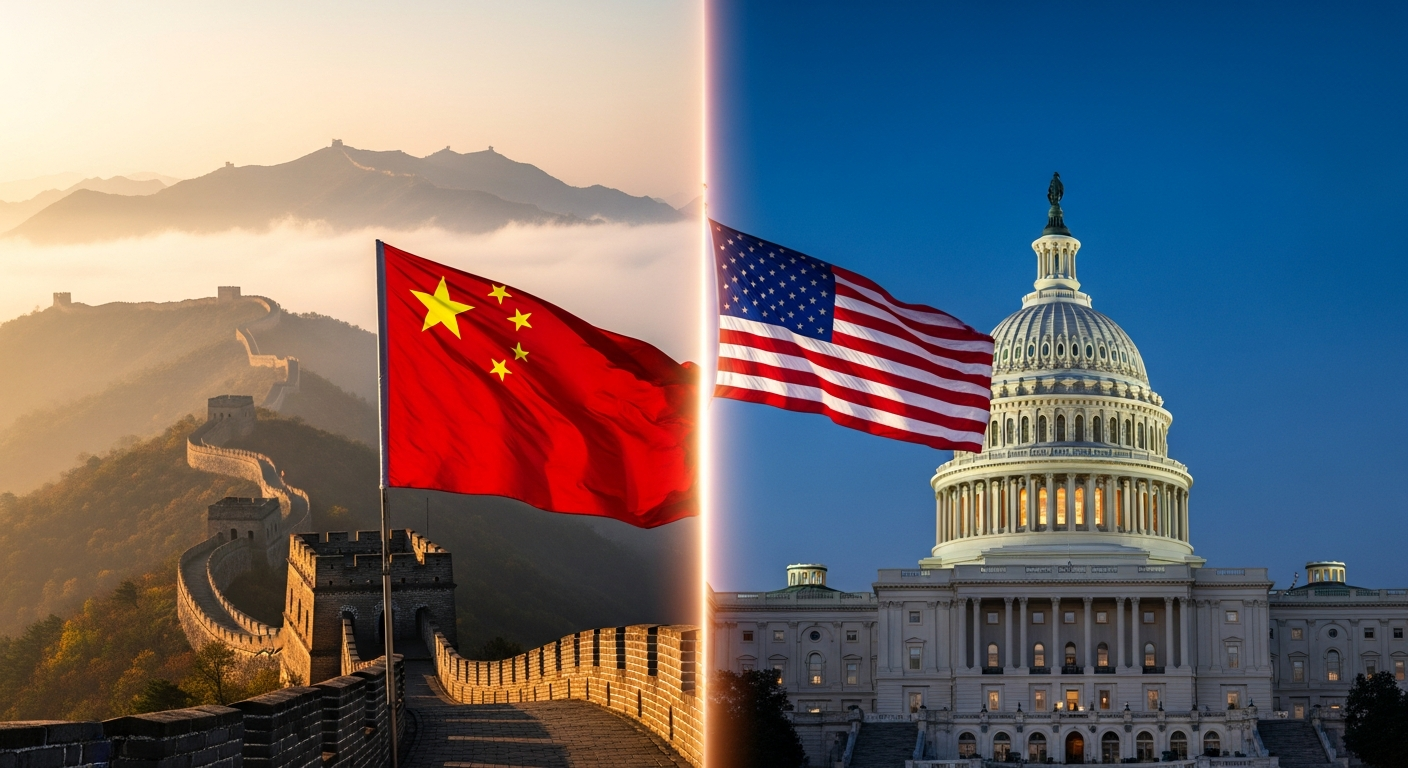
Donald Trump landed in Beijing this morning. The Iran war is three weeks old. The US-China trade war, technically paused since last year's partial deal, is still unresolved on the fundamentals. Taiwan remains what it has been: a trip wire neither side wants to discuss honestly.
Against that backdrop, Trump walked off Air Force One and into a summit with Xi Jinping that both governments described as historic. The press covered it accordingly. What they covered, though, depends on which outlet you read.
What the Summit Is Actually About
Three things are on the table, though only one is the reason this is happening now.
The Iran war is the immediate driver. China has spent the last three weeks maintaining its position as Iran's largest trading partner and primary diplomatic shield. Chinese state media has called the US military involvement in the Strait of Hormuz "destabilizing." Beijing abstained rather than vetoed on the UN Security Council resolution last week, which was a small diplomatic signal that it hasn't fully closed the door.
Trump wants Xi to pressure Iran toward a ceasefire, or at minimum to stop providing economic oxygen to a country the US is now actively engaged with militarily. Xi wants concessions on trade, Taiwan, and technology export controls in exchange for anything that looks like cooperation. That is the negotiation happening behind the protocol photos.
The second agenda item is the broader trade relationship. The tariff regime from 2025 is still in place on most goods. Both sides want some version of normalization, but neither has been willing to absorb the domestic political cost of a visible concession. A summit creates space for both leaders to announce progress without either side admitting they moved.
Taiwan sits in the background of everything, as it always does. No formal agenda item. Very much present.
Two Framings, One Summit
Right-leaning coverage frames this as Trump's strength on display. The argument is that a US president flying to Beijing while simultaneously running a military operation in the Middle East projects an image of a leader operating from a position of power. The framing emphasizes deal-making, Trump's personal relationship with Xi, and the idea that only Trump could conduct simultaneous negotiations on two fronts. Some outlets have called it Nixonian in scope, which is meant as a compliment.
Left-leaning coverage frames this as a sign of overextension. The argument is that a president flying to Beijing mid-war suggests the Iran operation has produced complications that require Chinese buy-in to resolve, and that trading away bargaining position on trade and Taiwan in exchange for diplomatic cover on Iran is a bad deal dressed up in pageantry. The framing emphasizes strategic incoherence, the costs of the Iran engagement, and the question of what Xi extracts in return for anything he gives.
Both framings are working from the same set of facts. The interpretive gap between them is about what those facts mean, and that gap is exactly what DailyComposite's scoring process is designed to surface.
What China Gets Out of This
Xi did not need Trump to come to Beijing. The optics of a sitting US president traveling to China while engaged in a foreign military conflict give Xi something valuable before a word is spoken: the appearance that the US needs China's cooperation more than China needs US goodwill.
That framing serves Beijing domestically and regionally. For China's neighbors watching Taiwan, the Strait of Malacca, and the South China Sea, a US president arriving hat in hand reinforces the narrative that the era of uncontested American primacy is over. Whether that narrative is accurate is less important, in the short term, than whether it is believed.
Xi will also use this summit to extract whatever he can on technology export controls, which have been the single most consequential US policy tool against China's semiconductor ambitions. Any loosening of those controls, or any commitment to slow their expansion, would be worth more to Beijing than anything else on the table.
What Trump Gets Out of This
Trump needs a ceasefire path in Iran that does not look like a retreat. The military operation has been more costly and more complicated than the initial framing suggested. Oil markets are reflecting that uncertainty. A diplomatic off-ramp that runs through Beijing, and that Trump can present as a product of his personal relationship with Xi, gives him a win-shaped outcome that does not require admitting the original strategy had limits.
Whether that outcome is actually achievable in a single summit is a different question. Summits between the US and China have a long history of producing communiques that both sides interpret differently within 48 hours. The press conference optics tend to age poorly.
The Bias Analysis
The framing divergence on this story is as clean as any DailyComposite tracks. The same president, the same trip, the same summit produces "strength" in one set of outlets and "desperation" in another. Neither word appears in the factual record. Both words appear constantly in the coverage.
This is worth understanding, because the China story is one where the media framing has real downstream effects. How American voters understand US-China relations shapes what policies they will accept, what concessions they will tolerate, and what outcomes they will interpret as victories. A press that consistently frames every China interaction through a predetermined narrative, whether hawkish or accommodating, makes it harder to have an honest national conversation about what the relationship should look like.
That honest conversation is harder to have when every summit visit reads as either a triumph or a humiliation before the meetings have concluded.
Frequently Asked Questions
Why did Trump visit China in May 2026?
Trump traveled to Beijing for a summit with Chinese President Xi Jinping amid the ongoing US military engagement with Iran. The primary objective is to seek Chinese pressure on Iran toward a ceasefire or diplomatic resolution, while also addressing the unresolved trade relationship and technology export controls. The summit takes place against a backdrop of active military operations in the Strait of Hormuz.
What does China want from the Trump-Xi summit?
China's primary interests include concessions on US technology export controls targeting Chinese semiconductor development, progress on the broader trade relationship, and a reduction in US pressure on Taiwan. Beijing also benefits from the optics of hosting a US president mid-conflict, which reinforces its regional positioning as an indispensable diplomatic power.
What is the Iran war's connection to the China summit?
China is Iran's largest trading partner and has provided diplomatic protection at the UN Security Council. The US needs Chinese cooperation, or at minimum non-interference, to reach a sustainable ceasefire in Iran. Trump is offering trade and technology concessions in exchange for Beijing's diplomatic pressure on Tehran. Whether that trade is achievable in a single summit is uncertain.
How is US media covering the Trump-Xi Beijing summit differently?
Right-leaning outlets are framing the summit as a demonstration of Trump's strength, pointing to his ability to conduct simultaneous diplomatic and military operations. Left-leaning outlets are framing it as a sign of overextension, arguing that flying to Beijing mid-war signals the Iran operation has produced complications requiring Chinese cooperation to resolve. DailyComposite scores this framing divergence across outlets daily.
What happened at previous Trump-Xi summits?
Trump and Xi met multiple times during Trump's first term, producing trade truces and joint statements that both sides frequently interpreted differently within days of the meetings. The 2019 G20 Osaka summit produced a trade war "pause" that lasted less than a year before tariffs resumed. Both governments have a pattern of using summit communiques for domestic messaging that does not match the other side's version of what was agreed.
What does the Trump-Xi summit mean for Taiwan?
Taiwan is not formally on the summit agenda, but any easing of US posture on technology exports or military commitments in the Indo-Pacific sends signals that Taiwan's government and military will read carefully. China consistently uses US-China summits to probe for softness on Taiwan's status. The level of detail in any joint statement on Taiwan's "one China" framing will be watched closely by governments across the region.